
Replacing Worry, Anxiety, and Stress with God’s Peace
In a world marked by chaos, uncertainty, and relentless pressure, countless people find themselves searching for peace. Yet true, enduring peace cannot be found in temporary remedies such as vacations, medications, or distractions. Lasting peace is discovered only in a restored and growing relationship with God. This guide explores how to replace worry, anxiety, and stress with the profound peace that only God can provide, drawing directly from Scripture in the New King James Version (NKJV). Whether you are navigating personal struggles, relational tensions, or the weight of global uncertainty, God’s peace is available to guard your heart and mind.
Join me as we dive into the Bible and research the steps to finding true peace.
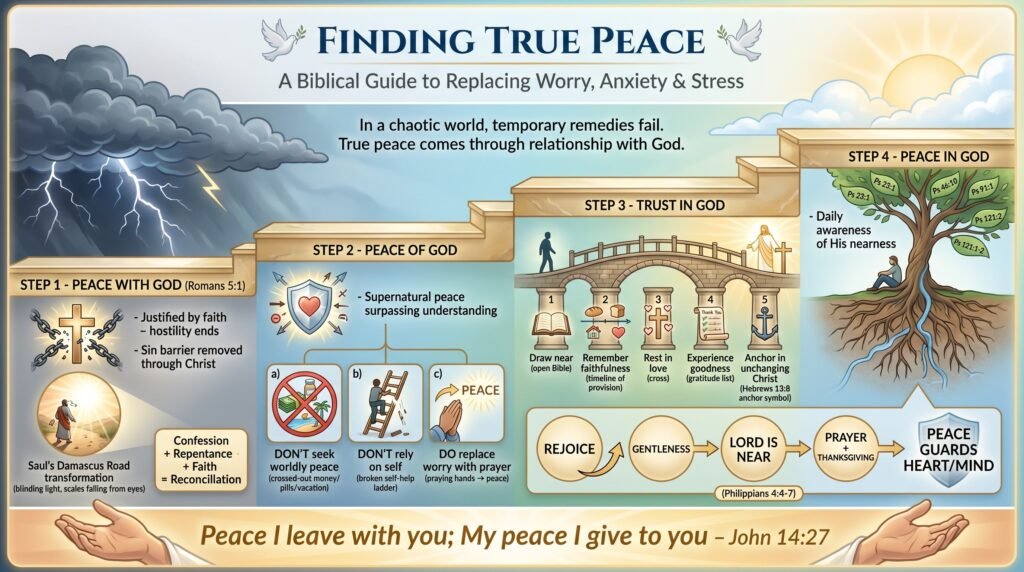
1. Peace with God (Romans 5:1)
The foundation of genuine peace begins with reconciliation with God.
Romans 5:1 declares: “Therefore, having been justified by faith, we have peace with God through our Lord Jesus Christ.”
This “peace with God” signifies the end of hostility between sinful humanity and a holy God. Through faith in the sacrifice of Jesus Christ, we are justified- declared righteous – not because of our own merit, but because of His finished work. This reconciliation removes the barrier of sin that once separated us from our Creator.
A powerful illustration of this transformation is seen in the life of Saul, later known as the Apostle Paul.
Acts 9:1–2 describes him as “breathing threats and murder against the disciples of the Lord,” actively persecuting the early church. Though zealous, Saul was profoundly opposed to God’s purpose.
Yet on the road to Damascus, he encountered the risen Christ in a blinding light – an encounter that radically altered the course of his life.
In Acts 9:17–18, Ananias lays hands on him and says: “Brother Saul, the Lord Jesus, who appeared to you on the road as you came, has sent me that you may receive your sight and be filled with the Holy Spirit.” Immediately, Saul’s sight was restored, he was baptized, and his life was forever transformed.
Later, Paul recounts this moment in Acts 22:12–14, where Ananias explains that God had chosen him to know His will, see the Just One, and hear His voice. Saul’s surrender resulted in forgiveness, purpose, and peace.
When we surrender to God, we accept His offer of salvation. If your life is not right with Him, now is the time to seek His forgiveness, repent, and receive His peace. Confession, repentance, and faith in Christ bring reconciliation. This peace is inseparable from salvation – without it, all other forms of peace remain incomplete.
This peace is not fragile; it is eternal. Regardless of your past – whether marked by failure, addiction, regret, or rebellion – God’s mercy extends to you. Just as scales fell from Saul’s eyes, spiritual blindness is lifted when we turn to Christ. Peace with God is the starting point for a transformed life.
2. The Peace of God (Philippians 4:7)
Once reconciled, we begin to experience the peace of God. Philippians 4:7 promises: “and the peace of God, which surpasses all understanding, will guard your hearts and minds through Christ Jesus.”
This peace is supernatural. It acts like a guard—protecting the heart and mind beyond human reasoning or circumstances. Jesus affirms this in John 14:27: “Peace I leave with you, My peace I give to you; not as the world gives do I give to you. Let not your heart be troubled, neither let it be afraid.”
This peace reflects wholeness and completeness. In 1 Thessalonians 5:23, Paul prays that God would sanctify believers entirely – spirit, soul, and body. God’s peace is not partial; it is holistic.
To cultivate this peace:
a) Do not seek peace in the world.
The world offers counterfeit peace through wealth, relationships, substances, or success – but these are temporary. Christ’s peace is internal, enduring, and unshakable.
b) Do not rely on yourself.
Isaiah 26:3 declares: “You will keep him in perfect peace, whose mind is stayed on You, because he trusts in You.” Fix your thoughts on God rather than your own understanding. Self-reliance often leads to anxiety when circumstances falter, but trust in God anchors the soul.
c) Replace worry with prayer.
Philippians 4:6 instructs us to present every concern to God with thanksgiving. Prayer redirects our focus from problems to the Problem-Solver. When anxiety arises, pause, pray, and remember God’s faithfulness. As we release our burdens to Him, His peace fills the void.
Many have experienced this peace in the midst of illness, loss, or hardship. It is not the absence of difficulty, but the presence of God within it that sustains us.
3. Trust in God
Trust is the bridge that sustains peace. Without it, peace quickly erodes under pressure.
a) Draw near to God.
James 4:8 says: “Draw near to God, and He will draw near to you.” Through prayer, worship, Scripture, and obedience, our relationship deepens, and His peace replaces anxiety.
b) Remember God’s faithfulness.
God never fails. Reflecting on His past provision, protection, and guidance strengthens confidence for the future.
c) Rest in God’s love.
The cross is the ultimate demonstration of God’s love. Romans 5 reminds us that Christ died for us while we were still sinners. This love dispels fear and replaces anxiety with security.
d) Experience His goodness.
Psalm 34:8 invites us to “taste and see that the Lord is good.” Gratitude shifts perspective and reveals God’s goodness in daily life.
e) Do not let circumstances dictate your peace.
Hebrews 13:8 reminds us that Jesus Christ is unchanging.
“Jesus Christ is the same yesterday, today, and forever.” Circumstances change, but God does not. Economic downturns, health issues, or relational strife cannot alter His character. Anchor in His immutability to maintain peace amid storms.
Trusting God is a daily choice. When worry creeps in, declare Scripture aloud. Journal promises. Surround yourself with a faith-filled community. Over time, trust becomes habitual, and peace becomes your default.
Trust is cultivated daily. As it grows, peace becomes a steady, defining reality.
4. Peace in God
Peace in God is the experience of abiding continually in His presence.
Lamentations 3:22–23 assures us: “Through the Lord’s mercies we are not consumed… They are new every morning; great is Your faithfulness.” Even in seasons of sorrow, God’s mercy renews our peace.
Psalm 119:165 declares: “Great peace have those who love Your law.”
Loving God’s Word provides stability and direction. Obedience to God’s Word provides stability and guards against stumbling into anxiety.
Psalm 62:8 encourages us to pour out our hearts before Him. Pouring out hearts honestly before God lightens burdens and invites His comforting peace.
Psalm 46:1 reminds us that God is “a very present help in trouble.”
In turmoil – natural disasters, personal crises – He is immediately available. This “very present” help replaces stress with confident reliance.
Abiding in God means living aware of His nearness. Meditation on these truths, combined with worship, cultivates an inner sanctuary untouched by external chaos. Peace in God is relational and experiential, growing deeper through trials as we see His deliverance.
Living in this awareness transforms our inner world. Peace becomes not just a concept, but a daily experience rooted in relationship.
Philippians 4:4–7: A Practical Pathway to Finding True Peace
Philippians 4:4-7 ties it together: “Rejoice in the Lord always. Again, I will say, rejoice! Let your gentleness be known to all men. The Lord is at hand. Be anxious for nothing, but in everything by prayer and supplication, with thanksgiving, let your requests be made known to God; and the peace of God, which surpasses all understanding, will guard your hearts and minds through Christ Jesus.”
Rejoicing shifts focus. Gentleness reflects Christ’s character. Awareness of the Lord’s nearness calms fears. Prayer with thanksgiving replaces anxiety. The result? Supernatural peace guarding the heart and mind.This passage provides a clear path to peace:
- Rejoice in the Lord always
- Let gentleness define your character
- Remember that the Lord is near
- Replace anxiety with prayer and thanksgiving
The result is God’s supernatural peace guarding your heart and mind.
Conclusion: Peace I Leave with You
Jesus’ parting words echo through the ages: John 14:27 – “Peace I leave with you, My peace I give to you; not as the world gives do I give to you. Let not your heart be troubled, neither let it be afraid.“
This peace is a gift, received by faith and cultivated through surrender, trust, prayer, and obedience. It replaces worry, anxiety, and stress as we fix our eyes on the Prince of Peace.
If you’re burdened today, pause. Confess any sin hindering peace with God. Draw near in prayer. Meditate on these verses. Let His peace flood your soul. Share this peace with others – your transformed life becomes a testimony.
True peace isn’t denial of problems but victory over them in Christ. May the God of peace sanctify you completely and guard you in every season. Embrace His peace today and walk in the wholeness He offers.
Leave a Reply