

Few people enjoy talking about funerals, final expenses, or what should happen after they die. We prefer to focus on living, enjoying our families, and making the most of the years God has given us. Final expense planning is a loving gift you can leave your family.
Yet preparing for the end of life is not the same as giving up on life.
It can be an act of love, responsibility, and faithful stewardship. By putting your wishes in writing and preparing for the expenses your family may face, you can spare your children and grandchildren from making difficult financial decisions while they are grieving.
When a loved one dies, family members may need to make numerous decisions within a very short time. They may have to choose a funeral home, burial or cremation arrangements, a casket or urn, transportation, flowers, an obituary, a cemetery plot, and a memorial service.
They may also need to locate insurance policies, obtain death certificates, contact government agencies, secure the home, manage bills, and notify banks and other organizations.
Without advance planning, confusion and emotion can easily lead to disagreement, delays, and unexpected expenses.
Final expense planning allows you to answer many of these questions now—calmly, prayerfully, and without the pressure of an immediate loss.

What are final expenses?
The term “final expenses” is often associated with funeral costs, but it can cover considerably more than the funeral itself.
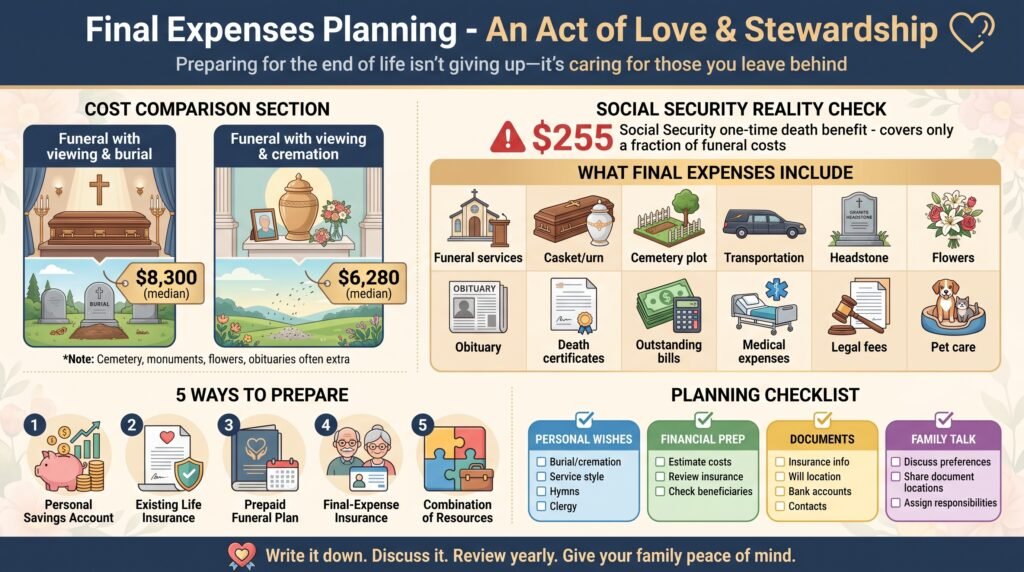
Potential final expenses may include:
- Funeral-home services
- Burial or cremation
- A casket, urn, or alternative container
- Embalming or other preparation
- Transportation of the deceased
- A cemetery plot
- Opening and closing the grave
- A burial vault or outer container
- A headstone or memorial marker
- Flowers and printed funeral programs
- Obituary publication
- Clergy, musicians, or other service participants
- A memorial meal or family gathering
- Copies of the death certificate
- Travel expenses for family members
- Outstanding medical bills
- Credit-card balances and household bills
- Legal, accounting, or estate-administration expenses
- The care of a surviving spouse or dependent
- The care or rehoming of pets
Not every family will face all these costs. A simple cremation followed by a family memorial may cost considerably less than a traditional funeral with a viewing and cemetery burial.
The important question is not whether your family would choose the most elaborate arrangement. It is whether money would be readily available to carry out your wishes without creating hardship.
How much might a funeral cost?
Funeral expenses vary according to location, provider, and the choices made by the family.
The National Funeral Directors Association’s 2023 pricing study reported a national median cost of $8,300 for a funeral with viewing and burial. The median cost of a funeral with viewing and cremation was $6,280. Certain expenses—such as cemetery charges, monuments, flowers, and obituaries—may not be included in those totals. National Funeral Directors Association
These figures are not predictions of what your funeral must cost. Families have many choices, from traditional arrangements to direct cremation, green burial, religious services, celebrations of life, and small private memorials.
Nevertheless, the figures demonstrate why families can experience financial pressure when no money has been set aside.
Will Social Security pay for a funeral?
Some people assume Social Security will provide enough money to cover their funeral expenses.
That is unlikely.
Social Security may provide a one-time lump-sum death payment of $255 to an eligible surviving spouse or, in some situations, an eligible child. The benefit is not paid automatically to everyone, and you generally must apply within two years of the death. Social Security Administration
Although every contribution can help, $255 would cover only a small fraction of most funeral arrangements.
Some families may qualify for additional assistance through veterans’ benefits, employer benefits, unions, religious organizations, or state and local programs. However, eligibility varies, and you should not assume assistance without confirmation.
If you or your spouse served in the military, investigate possible veterans’ burial and survivor benefits and keep service records accessible to your family.
Planning is about more than money.
Money is only one part of final expense planning.
Imagine that your children had to arrange your funeral tomorrow. Would they know what you wanted?
Would they know whether you preferred burial or cremation? Would they know which church to contact, which hymns you loved, where your important documents were stored, or whether you had already purchased a cemetery plot?
Family members often say, “Mom would have wanted this,” or “Dad would never have chosen that.” When wishes have not been discussed, sincere people may reach very different conclusions.
Writing down your preferences gives your family direction. It also relieves them from wondering whether they made the right choices.
Your wishes do not need to dictate every detail. You can leave room for your loved ones to make decisions that are appropriate at the time. Even a simple outline can provide considerable comfort.
Decide what kind of farewell you would prefer.
Begin by considering the broad nature of the arrangements you would want.
Questions may include:
- Would you prefer burial, cremation, or another lawful option?
- Do you already own a cemetery plot?
- Would you want a viewing or visitation?
- Should the service be held at a church, funeral home, graveside, or another location?
- Would you want a traditional funeral or a celebration of life?
- Which pastor, priest, or other faith leader should be contacted?
- Are there particular Bible readings, hymns, prayers, or songs you would like?
- Are there people you would want to speak or serve as pallbearers?
- Would you prefer flowers or donations to a church or charity?
- Where should family and friends gather after the service?
- Do you have preferences for a casket, urn, headstone, or memorial?
- Where should ashes be buried, stored, or scattered, subject to applicable laws?
- Is there a message you would like read to your family?
These decisions can reflect your faith, personality, values, culture, and family traditions.
For a Christian, the service may also become an opportunity to affirm the hope of eternal life and point grieving loved ones toward the promises of God.
Put your wishes in writing.
A conversation is valuable, but a written record is far more dependable.
Create a final-wishes document and tell at least two trusted people where it is stored. You might give a copy to your spouse, adult child, executor, pastor, attorney, or another responsible person.
Your document can include:
- Your full legal name
- Date and place of birth
- Social Security number and other identification details
- Names and contact details of immediate family members
- Preferred funeral home
- Burial or cremation preference
- Cemetery and plot information
- Church and clergy contact information
- Preferred service details
- Military service information
- Organ-donation instructions
- The location of your will and other legal documents
- Life-insurance company and policy details
- Prepaid funeral or cemetery contracts
- Bank and investment account information
- Professional advisers to contact
- Online accounts or digital legacy instructions
- People who should be notified
- Pet-care instructions
- A recent photograph for an obituary or memorial
- Information you would like included in your obituary
Do not place the only copy inside a safe-deposit box. Your family may be unable to access it immediately.
Review the document periodically. Preferences, relationships, policies, addresses, and financial circumstances can change.

Make sure your family can find your policies.
A life-insurance policy cannot help your beneficiaries if they do not know it exists.
Keep an organized record of:
- The insurance company
- Policy number
- Type and amount of coverage
- Name of the insured person
- Beneficiary information
- Agent or company contact details
- Premium-payment method
- Location of the original policy
- Any loans taken against the policy
Check that the beneficiary information is current. A beneficiary designation generally determines who receives the policy proceeds, so review it after marriage, divorce, death, or other major family changes.
If a family cannot locate a deceased person’s policy, the National Association of Insurance Commissioners provides a Life Insurance Policy Locator that may help beneficiaries search for lost policies and annuity contracts. NAIC Life Insurance Policy Locator
Ways to prepare for final expenses
There is no single correct method for every family. The best approach depends on your health, age, savings, existing insurance, family situation, and personal preferences.
1. Personal savings
Some people establish a separate savings account specifically for final expenses.
The advantage is flexibility. The money can be used for whatever the family needs, and you are not limited to a particular funeral provider.
However, there are questions to consider:
- Will the account contain enough when needed?
- Will the money remain untouched?
- Can the appropriate person access it promptly?
- Could probate or account-ownership rules delay access?
- Will inflation reduce its purchasing power?
- What happens if the money is needed for medical or living expenses?
A payable-on-death account or another appropriate arrangement may improve access, but banking and estate rules vary. Obtain qualified legal or financial advice before changing account ownership.
2. Existing life insurance
You may already have adequate life insurance coverage through an individual policy, employer, union, or pension arrangement.
Review the policy rather than assuming it will always provide the amount you remember.
Ask:
- Is the policy still active?
- Does the coverage expire at a particular age?
- Will premiums increase?
- Has the benefit been reduced?
- Is the policy tied to employment?
- Are the beneficiaries correct?
- Have loans or withdrawals reduced the benefit?
- Will the proceeds be sufficient for other family needs as well as the funeral?
A large policy intended to replace income, pay a mortgage, or support a spouse should not automatically be treated as a dedicated funeral fund. Your family may need those proceeds for several purposes.
3. A prepaid funeral plan
A prepaid arrangement allows you to select and pay for certain funeral goods or services in advance.
This may provide clarity and protect your family from having to make every decision during grief. But contracts can differ considerably.
Before prepaying, ask:
- Exactly which goods and services are included?
- Are the prices guaranteed?
- Who holds the money?
- Is the plan funded through a trust or insurance policy?
- What happens if the funeral home closes?
- Can you transfer the plan if you move?
- Are additional charges possible?
- Can you cancel the contract?
- Would you receive a full or partial refund?
- What happens if you die while traveling?
- Will another funeral home accept the plan?
- Who receives any remaining funds?
The Federal Trade Commission warns that prepaid plans may have transfer restrictions or additional costs. It also recommends telling your family about the arrangement so they do not unknowingly pay for services that have already been purchased. FTC guidance on planning your funeral
4. Final-expense insurance
Final-expense insurance—sometimes called burial insurance or funeral insurance—is generally a smaller life-insurance policy intended to provide money to a beneficiary after the insured person dies.
Many policies are forms of permanent life insurance, but features vary by company and state.
Potential advantages may include:
- Coverage designed for a relatively modest financial need
- A death benefit paid to the named beneficiary
- Coverage that may remain in force as long as required premiums are paid
- Simplified application processes for some policies
- Money that the beneficiary may use for funeral and other final expenses
However, it is important to understand the limitations:
- Premiums can be significant relative to the benefit.
- Availability and cost depend on age, health, location, and insurer.
- Some policies ask health questions, while others may offer guaranteed acceptance.
- A guaranteed-issue or graded-benefit policy may not pay the full death benefit for a nonaccidental death during an initial waiting period.
- Missing premium payments could cause the policy to lapse.
- The total premiums paid over many years could exceed the death benefit.
- Policy loans or other provisions may reduce the amount ultimately paid.
- Not every policy increases with inflation.
Never rely only on an advertisement or verbal explanation. Read the policy carefully and ask the agent to explain premiums, benefits, exclusions, waiting periods, and cancellation rights.
5. A combination of resources
Some families use more than one method.
For example, a person might combine:
- Existing life insurance
- A modest final-expense policy
- Personal savings
- A prepaid cemetery plot
- Veterans’ benefits
- Family resources
The goal isn’t necessarily to find one product that covers everything. The goal is to create a realistic, documented plan your family can understand and access.
Understand your rights when arranging a funeral.
Grieving families can feel pressured to make quick decisions. Fortunately, the Federal Trade Commission’s Funeral Rule gives consumers important rights.
These include the right to:
- Purchase only the goods and services you want
- Request price information by telephone
- Receive a written General Price List when visiting a funeral home.
- See casket prices before viewing the caskets.
- See prices for outer burial containers.
- Receive a written statement showing the selected items and total cost before payment.
A funeral provider cannot require you to purchase an unwanted package merely because it is convenient for the provider.
The FTC also notes that no state law requires routine embalming for every death and that funeral homes must accept a casket purchased elsewhere without charging a handling fee. FTC Funeral Rule
Understanding these rights can help your family make decisions based on your wishes and budget rather than emotion or sales pressure.
How to begin the conversation with your family
Talking about death can feel uncomfortable, especially when children or grandchildren do not want to imagine life without you.
Choose a calm time when there is no immediate crisis. You might begin by saying:
“I am healthy and grateful for my life, but I want to make things easier for you whenever my time comes. I have started writing down my wishes and organizing the information you may need.”
This reassures your family that the conversation is about preparation, not a hidden diagnosis or expectation of imminent death.
Explain:
- What arrangements you prefer
- Where your documents are stored
- Whether money or insurance is available
- Who should take responsibility for particular decisions?
- Which choices matter strongly to you
- Which decisions you are comfortable leaving to the family
Allow your loved ones to ask questions. They may have emotional, practical, or financial concerns you have not considered.
If disagreements arise, focus on the purpose of the conversation: providing clarity and reducing future stress.
A simple final-expense planning checklist
Use this checklist as a starting point:
Personal wishes
- Choose burial, cremation, or another lawful arrangement.
- Record your preferred funeral or memorial style.
- Select readings, hymns, prayers, or music.
- Record church and clergy contact details.
- Write down cemetery or ashes instructions.
- Prepare basic obituary information.
Financial preparation
- Estimate likely funeral and related expenses.
- Review existing savings and insurance.
- Confirm policy status and beneficiaries.
- Investigate military, employer, or other benefits.
- Compare final-expense funding options.
- Review any prepaid contract carefully.
Important documents
- Record insurance policy information.
- Identify the location of your will.
- Organize identification and military records.
- List bank, investment, and retirement accounts.
- Record adviser and attorney contact information.
- Prepare digital-account instructions.
- Tell trusted family members where everything is stored.
Family communication
- Discuss your preferences with loved ones.
- Give copies of your instructions to trusted people.
- Clarify who should make arrangements.
- Review the plan every year or after major life changes.
A final act of love and stewardship
None of us knows how many days we will be given. That uncertainty does not need to fill us with fear.
For those who trust in Christ, death is not the end of the story. Our hope rests not in a funeral plan, an insurance policy, or the money we leave behind, but in Jesus’ saving grace and the promise of eternal life.
Practical preparation still matters.
Putting your affairs in order is one way to care for the people you love. It can prevent confusion, reduce unnecessary expenses, and allow your family to focus on grieving, remembering, and supporting one another.
You do not have to complete everything in one day.
Begin with one step. Write down your wishes. Locate your existing policies. Estimate the expenses your family might face. Talk with your spouse or adult children. Then consider whether your current resources are adequate.
The most valuable part of final expense planning is not the paperwork or the financial product. It is the peace of knowing that you have done what you can to make a difficult day a little easier for those you leave behind.
Would Your Family Be Prepared for Your Final Expenses?
A licensed insurance agent can explain final-expense coverage options that may be available in your area and help you compare policy features, costs, waiting periods, and benefit amounts.
[Speak With a Licensed Insurance Agent]
Coverage, eligibility, benefits, and premiums vary by applicant, insurer, and state. Some policies may include health questions, exclusions, limitations, or a graded-benefit period. Speaking with an agent does not obligate you to purchase coverage.
This article is provided for general educational purposes and is not legal, tax, financial, or insurance advice. Consult appropriately qualified professionals regarding your personal circumstances.
Leave a Reply