
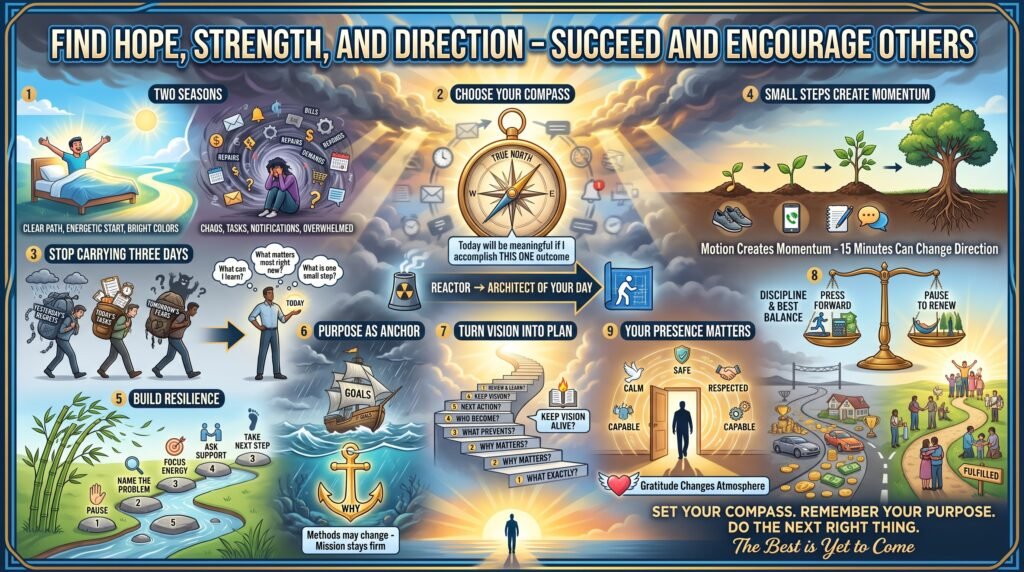
Find Hope, Strength, and Direction – Succeed and Encourage Others
We all need hope to lift our hearts, strength to overcome life’s challenges, and direction to move forward with purpose.
This motivational message will inspire you to pursue meaningful success, become the best you can be, and encourage others along the way.
Read it. Share it. Bless someone who may need these words today – and help them rise.
To your success,
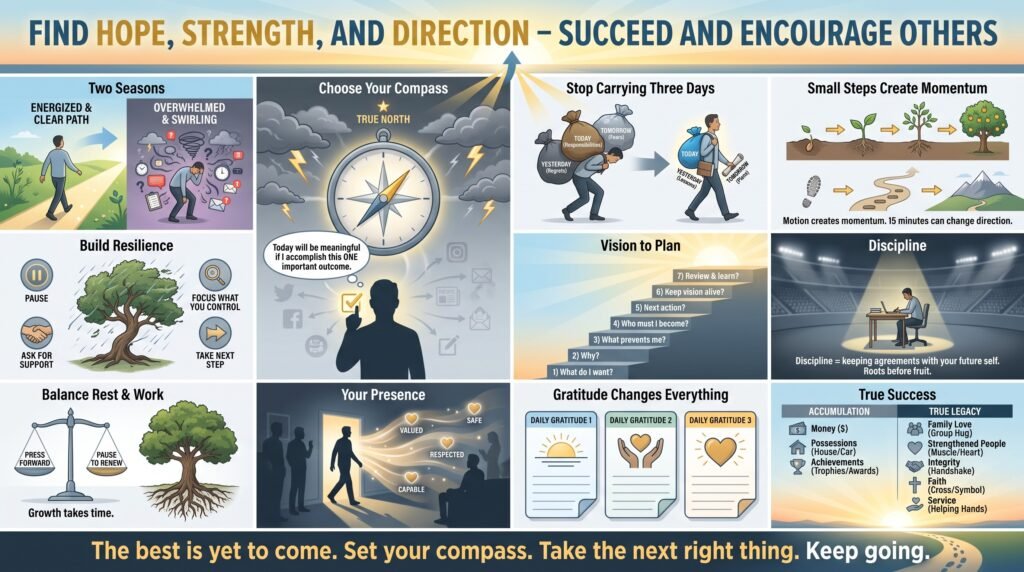
Some seasons of life feel full of possibility. We wake with energy, our plans seem clear, and progress comes naturally. Then there are seasons when everything appears to arrive at once. Responsibilities multiply. Unexpected problems interrupt our plans. The future becomes uncertain, and even simple decisions can feel heavy.
In those moments, we do not always need another complicated system or a dramatic reinvention of our lives. Sometimes we need encouragement. We need a reminder of what remains true when circumstances are difficult: we have more strength within us than we realize, progress is still possible, and one purposeful step can change the direction of an entire day.
Motivation is not reserved for athletes, entrepreneurs, or people pursuing spectacular dreams. We all need it. We need encouragement to care for our health, manage our homes, protect what we have built, strengthen our relationships, serve others, and face the future with hope. Whatever our age or interests, we need a reason to rise again after disappointment and continue becoming the person we were created to be.
Life’s storms may be loud, but they don’t have to determine our direction.
Choose Your Compass Before the Storm Chooses Your Course
Imagine beginning the day with a long list of tasks. Your inbox is filling, notifications demand attention, somebody needs an answer, something at home needs repair, and an unexpected expense has appeared. Before you have chosen what matters most, the world has begun choosing for you.
This is the storm: loud, urgent, chaotic, and constantly demanding a reaction.
Now imagine a compass. A compass is quiet. It does not compete with the noise around it. It simply points to true north.
Your daily compass can be one clear sentence:
Today will be a meaningful day if I accomplish this one important outcome.
That outcome will differ from one person to another. It may be completing an important piece of work, making a financial decision you have postponed, arranging a medical appointment, repairing something that has been neglected, spending uninterrupted time with someone you love, or finally taking the first step toward a long-held goal.
The important thing is to choose your compass before you enter the storm. When possible, give the first focused part of your day to that priority before opening the door to endless messages and minor demands. This small practice shifts you from reactor to architect of your day.
You may not control everything that happens, but you can decide what deserves your best attention.
Stop Carrying Three Days at Once
Many people are not exhausted by today’s responsibilities alone. They are carrying yesterday’s regrets and tomorrow’s fears at the same time.
Yesterday may contain mistakes, missed opportunities, painful words, failed plans, or choices we wish we could make again. Tomorrow may contain uncertainty about health, family, retirement, money, work, or the state of the world. When we pull all of that weight into the present, even a manageable day can feel unbearable.
The past should be a teacher, not a permanent address. Gather its lessons. Accept responsibility where necessary. Make amends where possible. Then invest the wisdom you gained into the future instead of repeatedly punishing yourself for what cannot be changed.
The future deserves preparation, but not constant fear.
Wise planning is an act of responsibility; endless worrying is an attempt to carry burdens before their time.
Today has enough strength for today’s assignment. Ask yourself:
- What can I learn from yesterday?
- What can I prepare for tomorrow?
- What is mine to do today?
Then return to the present. Life is lived here – not in the yesterday we cannot revisit, or the tomorrow we cannot yet enter.
Your Next Step Does Not Have to Be Large
The greatest journeys rarely begin with a grand gesture. They begin with a small, sometimes unimpressive step.
When a goal feels overwhelming, we often assume we need more motivation before we can act. In reality, action frequently creates motivation. A short walk can restore energy. One phone call can unlock a stalled decision. Ten minutes spent organizing a room can create visible order. One page written can break the fear of beginning. One honest conversation can start repairing a relationship.
Motion creates momentum.
Do not despise small beginnings. A seed does not resemble the tree it will become. A foundation does not look like a completed home. A first deposit may seem insignificant beside a long-term financial target. Yet every worthwhile result is built from actions that once appeared small.
Consistency gives those actions power. A dramatic burst of effort followed by months of inactivity seldom changes a life. Modest actions, repeated faithfully, can transform health, knowledge, finances, relationships, and character.
If you feel stuck, reduce the next step – but don’t remove it. Ask, “What can I do in the next fifteen minutes that moves me in the right direction?” Then do that. Tomorrow, take another step.
Build a Mind That Can Bend Without Breaking
Resilience does not mean pretending that life is painless. It does not require us to deny disappointment, hide grief, or act strong every moment. Resilience is the ability to experience hardship without allowing hardship to write the final chapter.
Life will test every one of us. Plans fail. People disappoint us. Bodies become tired. Markets change. Homes need attention. Careers take unexpected turns. Families enter difficult seasons. At times, we may be knocked down through no fault of our own.
We cannot always choose what happens to us, but we can influence what happens within us. We can decide whether pain will make us permanently bitter or increasingly compassionate. We can allow a setback to become a verdict, or we can treat it as information. We can remain on the ground, or – when we are ready – we can rise once more.
The resilient person is not the one who never feels discouraged. It is the person who does not make a permanent decision during a temporary storm.
When you are tested:
- Pause before reacting. Strong emotions can be honest without being wise advisers.
- Name the real problem. A defined problem is easier to face than a cloud of general anxiety.
- Separate what you can influence from what you cannot. Spend your strength where it can make a difference.
- Ask for support. Courage is not isolation. Wise people draw on helping hands.
- Take the next constructive step. Progress restores a sense of urgency.
You do not need to see the entire staircase before taking the first step. Clarity often comes through forward movement.
Let Purpose Become Your Anchor
Goals tell us what we want to accomplish. Purpose reminds us why it matters.
Without a strong “why,” discipline begins to feel like punishment. With a meaningful purpose, sacrifice becomes an investment. The early morning, the difficult conversation, the careful budget, the repeated practice, and the patient rebuilding all become connected to something greater than the discomfort of the moment.
Ask yourself what you genuinely want your life to stand for. Not what impresses others. Not what the culture says you should want. What matters deeply to you?
Perhaps you want to create security for your family, become healthier so you can enjoy your grandchildren, use your experience to guide younger people, build a business that serves others, deepen your faith, restore your home, protect your retirement, or finally develop a gift that has remained unused for too long.
Write it down. A goal in writing becomes a decision you can revisit. Then identify the reason beneath it. A powerful goal is not merely “I want more money,” but “I want the freedom to care for my family, give generously, and live without avoidable financial fear.” It is not merely “I want to improve my health,” but “I want the strength and mobility to participate fully in the lives of those I love.”
Purpose is an anchor that remains firm even when the route must change. You can alter your method without abandoning your mission.
Turn Vision Into a Workable Plan
Dreams awaken possibility, but plans give possibility a path into the real world.
Start by choosing no more than three meaningful goals for the season ahead. Too many priorities often mean that nothing receives priority. For each goal, work through these questions:
1. What exactly do I want?
Make the outcome clear enough that you will recognize progress. “Improve my finances” is vague. “Build a three-month emergency reserve over the next eighteen months” gives you something to plan.
2. Why does it matter?
Your reason must be strong enough to outlast the first wave of enthusiasm. Write down who will benefit and how your life may change.
3. What could prevent me?
Be honest about obstacles. Lack of time, fear of failure, distraction, limited knowledge, inconsistent habits, and others’ opinions can all get in the way. Obstacles seen in advance can be planned for.
4. Who must I become?
Every significant goal asks something of our character. You may need to become more patient, organized, teachable, courageous, disciplined, or willing to ask for help.
5. What is the next practical action?
Turn the goal into weekly and daily steps. Start small enough to remain consistent and build from there.
6. How will I keep the vision alive?
Regularly picture the result, but also picture yourself doing the work required to reach it. Vision without action becomes fantasy; action connected to vision becomes progress.
7. How will I review and learn?
Keep notes or a simple journal. Record what you did, where you struggled, and what you will change. Measure yourself not only by immediate results but also by the quality of your effort, decisions, and discipline.
Break large goals into shorter cycles – perhaps ninety days at a time. This creates urgency without making the entire journey feel overwhelming.
Discipline Works When Nobody Is Applauding
There is little applause for ordinary consistency. Nobody gathers to celebrate because you followed your budget, completed your exercises, studied for thirty minutes, maintained your property, kept a promise, or worked steadily on a project when you did not feel inspired.
Yet these quiet actions build the life that people later call successful.
Talent is useful, but talent without application remains potential. Knowledge matters, but a little knowledge acted upon can accomplish more than a library of ideas left unused. Ideas do not work unless we do.
Discipline is not about treating yourself harshly. It is about keeping an agreement with your future self. It says, “This matters enough for me to continue after the mood has passed.”
Motivation may help you begin, but commitment carries you through the middle – the long stretch where results are not yet visible. Small gains are accumulating there, even when you cannot see them. Roots develop before fruit appears.
Keep showing up. One day the result may seem sudden to others, but you will know it was built in hundreds of quiet moments.
Know When to Press Forward and When to Pause
Perseverance is powerful, but wise perseverance includes rest.
There is a time to press forward and a time to pause. Both can be acts of strength. Rest is not always a retreat from purpose; often it is preparation for purpose. It restores clarity, renews patience, and lets us return with better judgment.
Burnout can make every task feel equally urgent, and every problem feel personal. When exhaustion speaks, it often tells us that we are failing, that nothing is working, or that we must push harder.
Sometimes the most responsible response is to sleep, breathe, walk, pray, laugh, spend time in nature, or speak honestly with someone we trust.
The towering oak did not become strong overnight. It grew slowly and well. Your life does not become less meaningful because growth takes time.
Rest, however, should restore movement rather than become a hiding place. Pause deliberately. Decide what renewal looks like, and then return to your compass with fresh strength.
Guard the Presence You Bring Into a Room
One of the most powerful things you carry is your presence.
Long after a conversation ends, people may forget the exact words you used, what you wore, or the details of the occasion. They are more likely to remember how they felt around you. Did they feel judged, tense, unseen, or diminished? Or did they feel calmer, safer, respected, and more capable?
This matters at home, at work, in business, in our communities, and online. Technical knowledge may solve a problem, money may create options, and a beautiful home may offer comfort. Still, our presence determines whether the people around us experience those places as life-giving.
Take care of your mind. Process your emotions before passing them to others. Guard your energy without becoming closed. Speak firmly when necessary, but do not make another person smaller to prove your strength.
Encouragement is not empty flattery. It is the ability to recognize effort, possibility, and goodness, then put that recognition into words. Creativity often blooms where sincere appreciation is present and withers where constant discouragement dominates.
Look for opportunities to help, inspire, or lend support. Some people are too tired to offer a smile; give them one of yours. It costs little, but its memory may last far longer than you know.
Gratitude Changes the Atmosphere
Gratitude does not deny hardship. It refuses to let hardship become the only truth we can see.
When we deliberately notice what remains good- a faithful spouse, loving children, grandchildren, a safe place to sleep, eyes that can see a sunrise, ears that can hear birdsong, work that still has meaning, lessons gained through difficulty – our inner atmosphere begins to change.
Gratitude has three movements: we feel it in the heart, express it in words, and return it through generosity. Unexpressed appreciation is easily lost. Tell people what their presence, work, loyalty, or kindness means to you. Let gratitude become action.
For a team, gratitude builds trust and renews morale. In a family, it softens the tendency to take one another for granted. In an individual life, it interrupts the endless message that we never have enough and are never enough.
You can practice gratitude without waiting to feel cheerful. Begin with three specific things each day. Over time, attention changes perception. You start seeing resources where you previously saw only limitations, helpers where you saw isolation, and opportunities where you saw inconvenience.
Faith deepens this practice. It reminds us that even in seasons we do not understand, we are not abandoned. God does not promise a life without pain or rain, but He gives strength for the day, comfort in sorrow, and light for the next part of the way.
Success Is More Than Accumulation
It is wise to build, save, improve, and protect. Financial security matters. A well-maintained home matters. Meaningful work matters. These things can support our families, reduce avoidable stress, and enable generosity.
But they are poor substitutes for purpose.
At the end of life, few people will wish they had spent less time loving their family so they could accumulate one more possession. Wealth without peace is a costly bargain. Achievement without integrity is an empty trophy. A beautiful house without kindness is not truly a welcoming home.
Balanced success rests on deeper foundation stones: honesty, character, integrity, faith, love, loyalty, and service. These qualities guide how we use everything else we gain.
Ask not only, “What am I building?” but also, “Who am I becoming while I build it?” Ask not only, “What will I leave to others?” but also, “What will I leave within them?”
The finest legacy may be a family that remembers your love, people who grew stronger because you believed in them, work completed with excellence, wisdom shared generously, and a life sincerely offered in service to the God who gave it.
Begin Again – Today
Perhaps you have delayed something important because you fear the time it will take. The time will pass anyway. You might as well use it meaningfully.
Perhaps a previous attempt failed. An attempt can fail without making you a failure. Learn, adjust, and try again.
Perhaps you believe you are too old to begin. Age may change the pace and shape of a dream, but it can also bring patience, perspective, skill, and freedom from the need to impress. Your experience is not excess baggage; it is material from which you can build a wiser future.
Perhaps you are simply tired. Then rest – but do not surrender your hope.
You still have something to contribute. There is a gift, insight, kindness, solution, or word of encouragement within you that somebody else may need. You do not have to transform the whole world today. Improve the part within your reach. Make the call. Write the page. Take the walk. Repair the relationship. Review the plan. Offer the smile. Say the prayer. Complete the first hour of the day before facing the storm.
The best day to take ownership of your life is not hidden somewhere in the future. It is the day you stop waiting for perfect circumstances and decide to work faithfully with what is already in your hands.
Set your compass. Remember your purpose. Do the next right thing.
The road may bend, but you do not have to break. The pace may be slow, but slow progress is still progress. The storm may be loud, but it is not your master.
There is strength within you. There is hope ahead of you. And there is someone beside you who may find the courage to continue because of the way you choose to show up today.
Keep going. The best is yet to come.
Leave a Reply