
What Is the Right Attitude?
Our attitude influences how we see ourselves, how we respond to challenges, how we treat others, and how willing we are to follow the vision God has placed within our hearts. What is the right attitude? How to trust God, begin again, and bless others is the beginning of your changed life. Start with gratitude to God for His grace, mercy, love, and forgiveness.
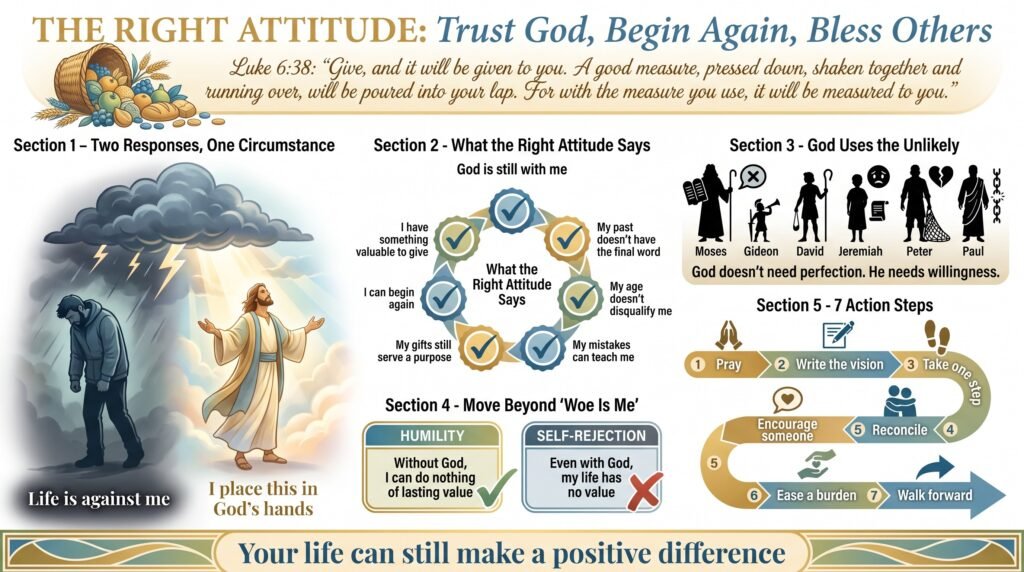
Two people can face the same disappointment and respond in completely different ways. One may decide that life is against them and there is no point in trying again. The other may acknowledge the pain, place it in God’s hands, learn from it, and take the next faithful step. The circumstances may be the same, but the attitude is different – and that difference can shape the direction of an entire life.
Having the right attitude does not mean pretending that everything is easy. It does not mean denying grief, disappointment, failure, or fear. Biblical faith is not positive thinking with God’s name added to it. It is the decision to trust God’s character even when we cannot yet understand His plan.
The right attitude says:
- God is still with me.
- My past does not have the final word.
- My age does not disqualify me.
- My mistakes can teach me.
- My gifts can still serve a purpose.
- I can begin again with God.
- I have something valuable to give to others.
Whether we are at school, university, building a career, raising a family, leading a business, serving in a church, or adjusting to retirement, we need to follow God with courage. Every season has its own opportunities, responsibilities, and tests. The setting may change, but the call remains: trust God, walk in obedience, and use what He has placed in your hands.
“Give, and it will be given to you: good measure, pressed down, shaken together, and running over will be put into your bosom. For with the same measure that you use, it will be measured back to you.” — Luke 6:38 (NKJV)
The Vision God Has Placed in Your Heart
Some dreams arise from pride, comparison, or the desire to impress others. Those dreams need to be surrendered.
But God also plants and develops desires within us: to serve, create, teach, lead, reconcile, protect, encourage, provide, or build something that will bless others.
We should not ignore those desires merely because we feel inadequate.
Perhaps you have carried an idea for years. You may want to start a ministry, write a book, restore a relationship, mentor younger people, launch a small business, volunteer in your community, or use your experience to help someone avoid the mistakes you made.
Perhaps your vision is not public at all. It is to create a peaceful home, become a more patient spouse, support your grandchildren, or live the remaining years of your life with deeper purpose.
The question is not whether your vision looks impressive to the world. The question is whether it aligns with God’s Word, is shaped by love, and is surrendered to His direction.
Following your heart does not mean following every emotion. Scripture reminds us that the human heart needs God’s guidance. A better way to understand the phrase is this: listen prayerfully for the God-honoring calling or desire He has placed within you, and then test it through Scripture, prayer, wisdom, and faithful action.
You do not need to see the whole journey before taking the first step. God often gives enough light for the next step, not a detailed map of everything ahead. Trust grows as we obey Him one decision at a time.
God Can Use Anybody Willing to Serve
God can use any man, any woman, and any child who is willing to put up a hand and say, “Lord, here I am. Use me.”
The Bible is filled with people who didn’t seem like obvious choices. Moses felt unable to speak. Gideon saw himself as the least important member of a weak family. David was overlooked when Samuel came to anoint a king. Jeremiah believed he was too young. Peter was impulsive and later denied knowing Jesus. Paul had actively persecuted the church.
Yet God’s power was not limited by their insecurity, history, or human weakness.
God does not require a flawless résumé. He looks for faith, surrender, repentance, and obedience. He can educate the inexperienced, strengthen the weak, restore the fallen, and open doors that no person could manufacture.
This truth matters even more after age 50. Society can make older people feel that their most useful years are behind them. Retirement can even be presented as a withdrawal from significance – a season devoted only to comfort, recreation, and waiting.
Rest and enjoyment are gifts, but retirement from a job is not retirement from God’s purpose.
Your experience has value. The lessons learned through success, disappointment, marriage, parenting, work, illness, loss, faith, and perseverance can become a source of wisdom for others. You may not have the same energy you had at 25, but you have insights you couldn’t have had then. God can use your testimony, time, prayer, kindness, resources, and presence.
Never confuse a change of season with the end of your calling.
Move Beyond the “Woe Is Me” Attitude
Many people struggle with low self-esteem. They compare themselves with others, focus continually on their weaknesses, and conclude that they are not clever, gifted, spiritual, attractive, wealthy, or important enough to make a difference.
Their inner conversation becomes, “Woe is me. Nothing works for me. Nobody notices me. It is too late. Someone else could do it better.”
Pain may explain this attitude, but it must not be allowed to govern the future.
There is a difference between humility and self-rejection. Humility says, “Without God, I can do nothing of lasting value.” Self-rejection says, “Even with God, my life has no value.” The first honors God; the second fails to recognize what His grace can accomplish through a surrendered person.
You do not overcome low self-esteem by telling yourself that you are superior to everyone else. You overcome it by seeing yourself truthfully: created by God, loved by Him, responsible for your choices, dependent on His grace, and entrusted with gifts to use faithfully.
When we remain trapped in self-pity, we often stop trying. We reject opportunities before anyone else can reject us. We bury our gifts because using them feels risky. We talk ourselves out of the very steps that could lead to growth.
The right attitude does not wait until all fear disappears. It takes the next responsible step while trusting God with the outcome.
Ask yourself:
- What belief about myself has been keeping me small?
- Am I calling something impossible when it is merely uncomfortable?
- Have I allowed a past failure to define my identity?
- What could I attempt if I truly believed God would guide me?
- Who might be helped if I stopped hiding my gifts?
You may not be able to change everything today, but you can change the direction you are moving in.
Trust God in the Places That Need Reconciliation
Brokenness appears in marriages, families, homes, businesses, churches, and individual lives. When trust has been damaged, communication has failed, or mistakes have accumulated over years, reconciliation can seem impossible.
Yet when we trust God and submit our attitudes to Him, the way forward often becomes clearer.
That does not mean every relationship will be restored exactly as we wish. Reconciliation requires truth, repentance, forgiveness, wisdom, and, where appropriate, healthy boundaries. One person alone cannot always achieve it. But we can control the spirit in which we respond.
Pride asks, “How can I prove that I am right?”
Love asks, “What response would honor God and open a path toward healing?”
Bitterness rehearses the injury.
Grace tells the truth but refuses to make resentment a permanent home.
Fear avoids the difficult conversation.
Courage prepares carefully, prays deeply, and speaks honestly with gentleness.
Sometimes the first step toward reconciliation is not a dramatic gesture. It may be an apology without excuses. It may be listening without interrupting. It may be admitting that your words caused harm. It may be seeking Christian counseling, returning something that is not yours, correcting a dishonest practice, or choosing to forgive while healing continues.
The right attitude makes room for God to work by replacing stubbornness with teachability.
Love Your Neighbor as Yourself
Jesus taught us to love our neighbor as ourselves. This command carries both a personal and outward responsibility. We are not called to despise ourselves, nor are we called to respect and love ourselves. We are to receive God’s love, understand our worth in Him, and extend practical love to the people around us.
Imagine what could change if we lived this way consistently.
In marriage, we would seek to understand rather than merely to win.
At work, we would treat colleagues, clients, employees, and competitors with dignity.
In business, we would value honesty above short-term gain and ask whether our products and services genuinely help people.
In church, we would notice the lonely person, welcome the newcomer, support the weary, and refuse to participate in destructive gossip.
In the community, we would pay closer attention to practical needs instead of assuming someone else will respond.
The love Jesus describes is not merely a warm feeling. It becomes visible through patience, generosity, truthfulness, compassion, encouragement, and service.
We may never know how far one act of kindness travels. A sincere word of encouragement could keep someone from giving up. A meal could remind a grieving person that they are not forgotten. A thoughtful introduction could open a career door. A prayer could give someone courage to face another day. A second chance could redirect an entire family.
God often answers people’s prayers through the obedient actions of other people. You may be one of those answers.
Blessed to Bless Others
Luke 6:38 presents a powerful principle of generosity: “Give, and it will be given to you.” Jesus describes a full measure – pressed down, shaken together, and running over. Then reminds us that the measure we use will be measured back to us.
This verse should not be reduced to a formula for obtaining wealth. Its setting calls us to a generous way of life, including mercy, forgiveness, and a refusal to condemn. The principle reaches beyond money. What measure of patience, compassion, forgiveness, encouragement, time, and practical help are we extending to others?
God blesses us so that we can bless others.
Some people have financial resources to share. Others have time, knowledge, contacts, a spare room, a reliable car, or the ability to repair something. Some can cook, teach, listen, organize, pray, or simply remain present when another person is hurting.
Do not underestimate what is already in your hand.
The biblical principle of sowing and reaping reminds us that seeds produce harvests. If we sow anger, criticism, dishonesty, and selfishness, we should not be surprised when relationships become barren. If we sow faithfulness, generosity, encouragement, and peace, we create conditions in which good fruit can grow.
We do not give to manipulate God or place Him in our debt. We give because His grace has already been generous toward us. We become open-handed because we belong to an open-handed Father.
This week, consider choosing one burden you can help to ease. It might be practical, emotional, spiritual, or financial. You do not have to solve another person’s entire life. Simply do the good that is within your ability to do.
The World Needs More Encouragers
We certainly need more encouragers in the world today.
People are surrounded by criticism. News feeds amplify outrage. Social media encourages comparison. Workplaces can leave people feeling replaceable. Families sometimes become so familiar with one another’s weaknesses that they stop acknowledging each other’s strengths.
An encourager does not flatter or offer empty praise. Genuine encouragement recognizes truth and calls out possibility. It says, “I see the progress you are making. I believe God is still working in your life. Your effort matters. Do not allow this setback to become your identity. Let us take the next step together.”
Encouragement can be both tender and courageous. Sometimes it comforts. Sometimes it challenges. A true encourager does not help someone remain in destructive behavior; they lovingly point toward a better way.
Barnabas provides a beautiful biblical example. His name became associated with encouragement. When others understandably feared Saul because of his violent past, Barnabas helped the believers understand the reality of Saul’s conversion. Later, when John Mark had failed on a missionary journey, Barnabas was willing to invest in him again. John Mark later became useful in ministry.
Who might need a Barnabas today?
Perhaps it is an adult child who needs to know that one poor decision has not destroyed the future. Perhaps it is a spouse carrying silent pressure. Perhaps it is a young colleague who needs wisdom rather than ridicule. Perhaps it is a pastor, caregiver, business owner, widow, student, or friend who appears strong but is privately exhausted.
Don’t assume people know you appreciate them. Say it. Write the message. Make the call. Name the quality you see. Remind them of God’s faithfulness.
Your Past Does Not Disqualify You
Many people cannot reconcile themselves with their past. They believe they have failed too severely and wandered too far for God to use them. They may accept that God forgives others while quietly believing their own case is different.
That belief is false.
The Bible repeatedly shows God working through people with deeply imperfect histories. Moses killed an Egyptian. David committed adultery and arranged the death of Uriah. Peter denied Jesus three times. Paul persecuted Christians. The Samaritan woman had a complicated personal history, yet her testimony brought others to Jesus.
These accounts do not excuse sin. They reveal the greatness of grace.
God does not call evil good. He calls sinners to repentance, forgives those who turn to Him, and transforms lives for His purposes. Your worst chapter does not have to be your final chapter.
You may still need to face consequences. Forgiveness does not always erase the earthly results of our choices. Trust may need to be rebuilt slowly. Restitution may be required. Some doors may remain closed. But God can still create a meaningful, fruitful future from a life that is honestly surrendered to Him.
Shame says, “Hide, because if people knew the truth, you would be rejected.” Grace says, “Bring the truth into God’s light, receive His mercy, and walk in a new direction.”
The enemy wants your past to become a prison. God can turn it into a testimony.
Repentance Means Turning and Starting Again
Repentance is more than feeling sorry. It means turning away from sin and turning toward God. It includes a change of mind that changes our direction.
We cannot continue deliberately in the same destructive pattern while claiming that we have repented. Genuine repentance asks:
- What must stop?
- What truth must I confess?
- Whom have I harmed?
- What should I repair where possible?
- What safeguards and support do I need?
- What new act of obedience should begin?
Repentance is not God humiliating us. It is God inviting us out of bondage.
The prodigal son came to his senses, left the distant country, and returned to his father. He did not merely sit among the pigs feeling guilty. He got up and went home.
Perhaps today is your moment to get up.
Stop rehearsing how badly you failed and begin responding to what God is asking you to do now. Confess honestly. Seek forgiveness. Accept wise help. Make the call. End the habit. Return what belongs to someone else. Step away from the compromising situation. Begin again.
The right attitude toward repentance is not, “I am worthless.” It is, “I was wrong, I need God’s mercy, and by His grace I will walk in a new direction.”
A Fruitful Life Is Still Available
Being fruitful after 50 does not require fame, a large platform, perfect health, or unlimited resources. Fruitfulness is faithfulness that produces good in the lives of others and brings glory to God.
You can be fruitful through prayer. You can be fruitful by mentoring one person. You can be fruitful by restoring peace in your family, serving faithfully in a small role, building an ethical business, sharing your testimony, or encouraging someone who has lost confidence.
Do not measure the worth of your life only by visible results. Seeds often grow underground before anything appears above the surface. You may never see the full outcome of the love and truth you sow.
Your responsibility is to remain available, obedient, and generous.
If God has given you another day, there is still an opportunity to love Him, serve someone, learn something, repair something, and sow a seed for the future.
Choose the Right Attitude Today
The right attitude begins with trust.
Trust that God is greater than your limitations. Trust that He can guide you through uncertainty. Trust that repentance opens the way to a new beginning. Trust that your age and history do not make you useless. Trust that what you give in love is never wasted in His hands.
Then turn that trust into action.
- Pray for clarity. Ask God to reveal any attitude that is keeping you trapped.
- Write down the vision. Identify the God-honoring desire or responsibility you have been postponing.
- Take one faithful step. Do something specific within the next 24 hours.
- Reconcile where possible. Apologize, forgive, speak truthfully, or seek wise support.
- Sow encouragement. Contact someone and offer sincere, specific encouragement.
- Ease a burden. Give your time, attention, knowledge, prayer, or resources.
- Refuse to live in the past. Learn from it, repent where necessary, and walk forward with God.
You cannot rewrite yesterday, but with God’s help, you can respond faithfully today. And today’s attitude will influence tomorrow’s harvest.
Put your hand up for God. Follow His direction. Use what He has given you. Love your neighbor. Sow generously. Encourage the weary. If you have fallen, repent and rise again.
Your life can still make a positive difference.
Prayer
Dear Lord,
I want to be someone who makes a positive difference in the lives of those around me. Please give me the right attitude – one of faith, humility, courage, generosity, and love.
Help me to recognize and follow the vision You have placed in my heart. When I feel inadequate, remind me that Your strength is greater than my weakness. When I am tempted to live with a “woe is me” attitude, help me to see myself through the truth of Your grace.
Father, show me where reconciliation is needed. Give me the humility to apologize, the grace to forgive, the wisdom to establish healthy boundaries, and the courage to do what is right.
Please forgive my sins. Help me to repent sincerely, turn away from what is wrong, and begin again in obedience to You. Do not allow my past to imprison me or prevent me from serving Your purpose.
Teach me to love my neighbor as myself. Make me generous with my time, words, abilities, and resources. Help me to remember that You bless me so that I can bless others.
I want to be an encourager and set a good example as a follower of Jesus. Please help me live a righteous, honorable life that reflects Jesus’ love to everyone I meet.
Use my life, in this season and every season, for Your glory.
In Jesus ’ name, Amen.
Leave a Reply