

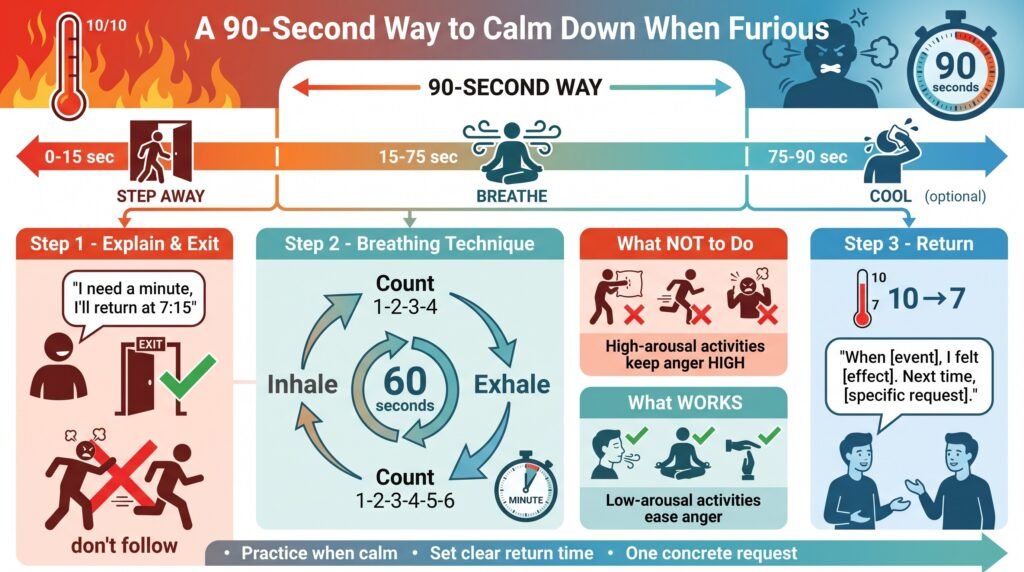
A 90-second way to calm down when you are furious and about to explode
When you are at 10/10, buy 90 seconds before you answer.
The reply is already forming, and your jaw has tightened as the other person keeps talking. That is the moment to buy yourself 90 seconds by following the 90-second way to calm down when furious guideline, because your next sentence may carry more force than you intend.
If you are learning how to calm down when you are furious, begin by lowering your body’s alarm. Clear thinking often returns as your breathing and muscle tension ease, so give yourself room for that shift.
If you want to know how to calm your nervous system fast, focus on a cue your body can follow while your mind is still caught in the argument. A step away and an easy, longer exhale are good places to start.
If you’re asking what to do when I’m about to explode, use this 90-second sequence. Step away for the first 15 seconds, then spend the remaining 75 seconds settling your body. Breathe with a longer exhale for 60 seconds, and use a cool, damp cloth or simply splash cool water on your face for the final 15 seconds.
Keep the cold mild, and leave it out if it feels unpleasant or your health makes cold exposure unsafe. Say, “I need a minute, and I’ll come back at 7:15,” then choose a return time you can keep.
The 90-second mark is a practical time box, and research has tested its individual parts under different conditions. People vary in how quickly anger eases, so use the time to make space for a better choice.
If you think you may hurt someone, move away and contact local emergency services or a trusted person who can help keep everyone safe. That space matters because acting on the urge can keep anger high.
Why blowing off steam can keep the fire going
Venting can feel like a release because talking it out gives anger somewhere to go. Repeating the grievance, shouting, or hitting a pillow can keep your attention fixed on the offense while your body stays keyed up.
A 2024 meta-analysis by Sophie L. Kjærvik and Brad J. Bushman combined 154 studies with 10,189 participants. Across the review, lower-arousal activities tended to ease anger. Activities that raised arousal offered little benefit and sometimes kept anger high (1).
A rant brings the same scene back into focus and rehearses your next reply, so your body keeps receiving cues that the conflict is still happening.
The review found that breathing, relaxation, mindfulness, and yoga or meditation reduced anger across lab and field settings. Taking a timeout also helped, which gives you a research-backed reason to create space before trying to settle the disagreement (1).
Jogging was among the activities most likely to raise anger in the review. Play-based movement sometimes lowered arousal, perhaps because enjoyable activity changes how the body reads the effort.
A hard run can add more activation when your system is already running hot, so exercise is an unreliable emergency plan. Gentle movement may suit you once the first wave has eased, especially if it usually helps you think.
After your body settles, talk about what happened and ask for a specific change. Name the trigger and the next step, since repeating the rage story can keep you circling the same moment.
Make your exit clear so the other person understands you are taking space and knows when you plan to return.
First, explain the pause before you leave.
An unexplained exit can feel like rejection or punishment, especially when the other person is already upset. A short sentence tells them what you are doing and gives the break a clear purpose.
Try, “I’m too heated to answer well. I need a minute, and I’ll come back at 7:15.” Choose a return time you can keep, even if the full conversation needs to wait longer.
Taking a timeout was among the arousal-lowering methods in the meta-analysis (1). Leaving gives your body fewer cues from the argument, which can make it easier to use the next minute well.
Walk to a safe nearby place and put physical distance between yourself and anything you might throw or break. If others need protection from the conflict, make their safety your priority.
Sometimes you share a small space, and leaving may feel unsafe. If so, stay where you are and ask for a pause. Turn your attention away from the exchange as you wait.
During the break, give your attention a small job: feel your feet on the floor and count each breath out as the urge to argue passes.
If the other person follows or keeps pressing, repeat your line once, then move to a place where you can stay safe. You are setting a boundary for this moment, and you can return to the issue when the pressure has dropped.
Once the talk pauses, use a breathing count as your next concrete task, since a steady rhythm can guide your attention while anger is still high.
Then give your body a concrete cue.
When anger peaks, “just breathe” can feel useless because you need a clear task. A simple count gives your attention something to follow, and a longer exhale gives your body a rhythm to repeat.
Breathe in gently for four counts and out for six counts. Repeat for about one minute, keeping the breath soft and comfortable. If six counts feels strained, make the exhale only a little longer than the inhale.
Teruhisa Komori’s 2018 study asked 10 healthy young men to breathe with a four-second inhale and a six-second exhale. The pattern increased high-frequency heart rate variability and lowered the LF/HF ratio, both indirect measures of autonomic activity, so the finding offers a limited physiological clue (2).
Cold can offer a separate sensory cue. If it feels grounding, run cool water over your face or hold a cool, damp cloth for a few seconds.
Manuela Jungmann and colleagues randomized 61 healthy participants to brief cold stimulation at the neck, cheek, or forearm. They found heart-rate and HRV changes with stimulation at the side of the neck (3).
The trial tracked cardiac responses, and the effect of face cooling on anger remains unknown. Treat mild face cooling as an optional sensory cue, with the neck result offering a limited physiological clue.
A slower breath and a mild cooling cue give your attention something physical to follow. Practice can make those cues easier to use under pressure.
Why “just breathe” can feel useless in the moment.
At 10/10, a vague instruction can feel like another demand because your attention is fixed on the argument. A count gives you a specific task for each breath, so you can follow a steady rhythm as your body settles.
A randomized study by M. Y. Balban and colleagues tested breathing practice with 111 healthy volunteers. Participants practiced for five minutes a day over 30 days, and cyclic sighing produced the largest daily improvement in positive affect among the breathing exercises (4).
Cyclic sighing uses two nasal inhales in a row, followed by one slow, full exhale. The practice also lowered resting breathing rate, while heart rate stayed unchanged (4).
The trial followed daily practice over 30 days and tracked mood and physiology; anger relief was not among the outcomes. Practice the pattern while calm, so it feels familiar if you want to try it under pressure.
On some calm days, set aside five minutes to practice a comfortable long exhale or cyclic sighing. Keep the breathing easy, and return to your normal rhythm if you feel dizzy or strained.
Practicing while calm makes the count familiar, so it takes less effort to recall when tension rises. Keep the breath comfortable as you rehearse a response you can use under pressure.
A steady count gives you more room to think, and you can use that space to make a clear request when you return.
Return to the problem with a clear request.
When the heat drops from 10 to 7, the problem may still matter. Take a moment to name the exact event that crossed your line and the change you need.
Speak about the event and its effect in plain words. You might say, “When the plan changed without warning, I felt dismissed. Next time, please call me before you decide.”
Ask for one concrete next step, and leave room for the other person’s account. You can own the volume of your voice and raise what happened clearly.
After you settle, ask yourself what felt unfair and what would help prevent it from happening again. That reflection can help you turn anger into information you can use next time.
A useful timeout includes a return point, so pick a time to continue or tell the other person when you can talk again.
For a Christian, self-control can help you care for the person in front of you and speak truthfully. James 1:19 urges believers to listen before speaking, and a pause can help you practice that wisdom when your body is surging.
When fury surges, protect the next minute by stepping away and letting your exhale grow longer. A mild cool cue can help you settle before you return with one clear request.
You may still feel angry, and the pause can give you more room to choose how to respond.
References
- Kjærvik, S. L., & Bushman, B. J. (2024). A meta-analytic review of anger management activities that increase or decrease arousal: What fuels or douses rage? Clinical Psychology Review, 105, 102318. https://doi.org/10.1016/j.cpr.2023.102318
- Komori, T. (2018). The relaxation effect of prolonged expiratory breathing. Mental Illness, 10(1), 7669. https://doi.org/10.4081/mi.2018.7669
- Jungmann, M., Vencatachellum, S., Van Ryckeghem, D., & Vögele, C. (2018). Effects of cold stimulation on cardiac-vagal activation in healthy participants: Randomized controlled trial. JMIR Formative Research, 2(2), e22. https://doi.org/10.2196/10257
- Balban, M. Y., et al. (2023). Brief structured respiration practices enhance mood and reduce physiological arousal. Cell Reports Medicine, 4(1), 100895. https://doi.org/10.1016/j.xcrm.2022.100895
Leave a Reply