

Stop forcing positive thinking if it feels fake to you.
Why “I am worthy” made you feel less worthy.
If you have ever said “I am worthy” to the mirror and walked away feeling smaller, your mind was very likely doing its job properly.
I spent a long stretch of my life taping sentences like that to the bathroom wall, and every morning they felt a little more like a lie I was being asked to sign.
For years I assumed that was my fault, because the advice sounded so sure of itself and I was the only part of the picture that seemed broken.
Then I read a set of 2009 experiments that changed how I saw the whole thing (1).
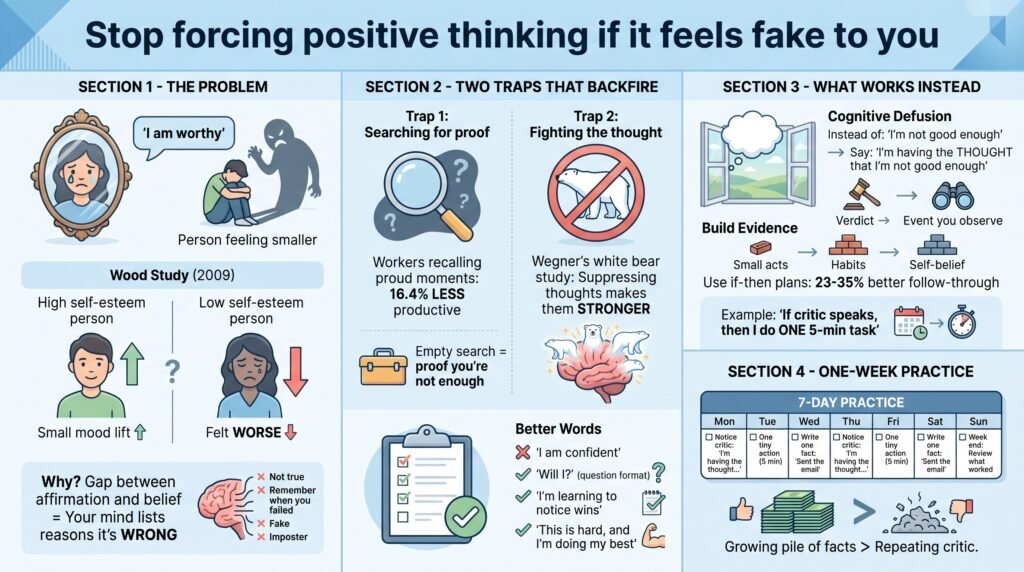
Joanne Wood and her colleagues asked people to repeat the sentence “I am a lovable person” and then measured how they felt. People with high self-esteem got a small mood lift.
People with low self-esteem felt worse afterward, and that pattern showed up across more than one experiment.
So the people who reach for affirmations because they feel worthless are the very people the practice is most likely to hurt, which is a hard thing to learn after months of trying.
The researchers had a plain explanation. When a sentence sits too far from what you believe about yourself, your mind checks it, finds the gap, and then quietly lists every reason the sentence is wrong.
That list is where the voice in my head that says I’m not good enough gets its fresh material, because I had handed it a claim to argue against.
One coach described saying “My body is beautiful” every day and feeling worse each time, because it “felt like I was telling myself a big fat lie.” For years I kept asking why positive thinking feels fake to me, and if her words sound familiar, you have your answer too, and it has very little to do with how hard you tried.
Another detail in Wood’s work that I will come back to later points straight at what helps.
The evidence is messier than either side admits
Before you throw out every kind thing you have ever said to yourself, the research deserves an honest look, because it is less tidy than the headlines suggest.
A clinical psychologist writing about a 2025 review of 67 studies reported that affirmations had a small but real effect on how people see themselves and on their sense of connection with others.
She also noted that some recent attempts to replicate the Wood findings haven’t produced the same results. So I hold the 2009 study a little loosely, and I think you should too.
What survives the mess is a narrower point: how believable a message feels matters more than how cheerful it sounds.
There is also a naming problem that explains a lot of the confusion. The word “affirmation” covers two very different practices, and most strong research focuses on the one people rarely do at home.
In the lab, self-affirmation usually means writing for a few minutes about a value that matters to you, such as your family or your faith, often just before something stressful.
The popular version means repeating trait claims like “I am confident” until they stick. That version borrows from lab research to call itself science-backed, which is how you ended up practicing the weakest-supported version while being told it was proven.
Christopher Critcher and David Dunning found something useful about how the lab version works (2). People who reflected on their values still saw a threatened part of themselves as just as threatened, yet rated it as less central to who they were.
The criticism stayed standing and simply took up less room in the person’s sense of self.
Keep that idea close, because it is the seed of what works, and first it helps to see the two traps that keep so many of us stuck.
Why searching for proof and fighting the voice backfire
The first trap looks harmless. You are told to remember times you felt proud or successful, so you sit down and try to make a list.
A study in The Economic Journal used exactly that exercise with workers who were paid for each piece they finished (3). Those asked to recall proud moments (I am worthy moments) produced 16.4% less than workers who simply described their daily routine.
Many struggled to name any proud (I am worthy) moments. A preregistered follow-up in the United States asked some people to recall eight successes and others to recall three, and the eight-success group got less done and felt less successful afterward.
The mechanism is easy to feel once you name it. When you search hard for evidence and come up short, your brain reads the empty search as proof of the opposite, so the effort itself turns into a quiet argument for the critic.
The second trap is fighting the thought head-on. In 1987, Daniel Wegner and his colleagues asked people not to think about a white bear, and the bear kept popping into their heads anyway (4).
Later, when the same people were allowed to think about the bear, they had more white-bear thoughts than people who had been free to think about it from the start.
Pushing a thought away keeps it loaded, and a loud affirmation often does exactly that to “I’m not good enough,” because each repetition is partly an attempt to shout the other sentence down.
This is when self-help affirmations make you feel worse in the most frustrating way, since the harder you try, the more room the critic gets. And that brings us back to the detail from Wood’s study that I promised to return to.
Notice the thought without arguing with it.
In the Wood experiments, people with low self-esteem were in a better mood when they were simply allowed to think their negative thoughts about themselves.
One therapist who wrote about this research added that several of her own clients told her they felt worse after doing the affirmations she had given them, which takes some honesty from someone in her job.
The skill that grows out of this comes from Acceptance and Commitment Therapy, where it is called cognitive defusion. You change your relationship to the thought and leave its content alone.
In practice, it is almost silly in how small it is. When the critic says, “I’m not good enough,” you tell yourself, “I’m having the thought that I’m not good enough.”
That little frame turns a verdict into an event, something you can watch happen the way you watch a car go past your window. You are no longer standing inside the sentence, so you can see that it has edges.
A thought can be partly true and still lose its grip, because in defusion it only has to be a thought.
That matters, because you have probably spent years losing a debate with your critic, and you are allowed to leave the debate. You can let it talk while you get on with your day.
Distance works through another door, too. Jason Moser, Ethan Kross,, and their colleagues had people recall painful memories while asking, “What is [Name] feeling?”, using their own name instead of “I” (5).
Their negative feelings dropped significantly, and brain markers of effortful control did not rise, meaning the calming happened without extra mental strain.
If you are tired, that is good news, because talking yourself into a brighter view leans on the brain’s control systems, and that kind of effort is in short supply when you already feel low.
Mindful noticing works through a different route: plain contact with what you feel, without judging it. Noticing loosens the grip, and then you need something real to put in the space it leaves.
Build evidence your critic can’t dispute.
Confidence that you can change mostly comes from doing things and watching yourself do them. Psychologists call these mastery experiences, and they are the most dependable source of self-belief we know about.
In one smartphone study aimed at reducing anxiety and low mood, people’s sense that they could handle things predicted improvement, while believing in a growth mindset did not.
Another trial found that strategies built around behavior and habits had the strongest effects, and work aimed only at changing traits produced almost nothing. The order seems to run from small acts to habits and then, slowly, to how you see yourself.
A counselor writing about his own struggle admitted he kept a secret list of affirmations that never worked for him. What changed things was behaving in ways that made him like himself, which for him meant writing a few hundred words a day.
His story captures the idea that you make the evidence fresh, today, and small enough that the critic has nothing to argue with, because the thing either happened or it didn’t.
So start by shrinking the action. Research on habits finds that behaviors people see as harder are less likely to stick, so a five-minute task you will actually do is worth more than an hour you dread.
Then tie it to a cue with an if-then plan. Peter Gollwitzer, who developed the idea, reviewed fifteen years of studies with Inge Gallo and found that adding such a plan raised follow-through by 23 to 35 percentage points in field studies (6).
In one study of daily vitamin C pills, 61% of people with only a goal missed doses after three weeks, compared with 26% of those who also made an if-then plan.
For our purposes, the cue can be the critic itself. “If the voice says I’m useless, then I do one five-minute task”, and that task might be one email or a short walk round the block.
The last piece is letting the evidence in. People with low self-esteem tend to wave away compliments, and Danielle Kille and her colleagues found that a concrete mindset helped: accept the specific thing said about one moment without testing it against your whole self (7).
So when a friend says you handled the meeting well, keep it at that size. “I handled that meeting well” is a sentence the critic finds hard to fight, and once you have a few of those, the words you say to yourself start to feel less hollow.
If you still want words to say to yourself
Some people like having a sentence to hold onto, and that is fine. The trick is choosing words that your critic cannot call a lie.
Ibrahim Senay and his colleagues found that people who asked themselves “Will I?” before a task did better than people who told themselves “I will” (8). A question sends your mind looking for a way through the task, which is a far kinder job to give it.
Bridging statements work similarly. “I’m learning to notice my wins” is true on the day you say it, so it slips past the guard.
The coach who felt like a liar switched to beliefs she called “uncomfortable yet attainable,” and I think that phrase is a good test for any sentence you try.
You might hear that affirmations only fail when you say them without enough feeling, and some teachers insist that months of repetition with strong emotion will make them work. I understand the appeal, and I tried it for a long time.
Emotion makes a sentence louder, though, and the problem was always believability. Saying an unbelievable sentence more forcefully tends to widen the gap you feel, the same contrast Wood described.
Gentle phrases can sit here too, as long as they are plain. “This is hard right now, and I’m doing my best” asks nothing of you except to admit what is true.
If even a kind phrase sets off a spiral, try talking to yourself the way a fair supervisor would, because that voice may feel more believable for now than a loving friend.
Words help a little, and actions do most of the work, so here is how I would put both together over seven days.
A one-week starting practice
Keep this small enough that you could do it on a bad day, because bad days are when it counts most.
- • Each day, notice the critic once and name it, either with “I’m having the thought that…” or by asking what [your name] is feeling.
- • Each day, do one tiny action tied to an if-then cue, ideally five minutes or less.
- • Each day, write one line about what you did in plain facts, such as “Sent the email I’d been avoiding.”
- • At the end of the week, read the whole log once, slowly, and keep the actions that worked.
When you look back, check whether the actions happened, and leave your mood out of the score for now.
If even the five-minute version keeps failing, make it smaller. Shrinking a step is a design fix and says nothing about your character.
If your low mood stays heavy for weeks, or your sleep and appetite change, please talk to a doctor or therapist as well.
The week will not make the critic disappear, and you will probably still hear “I will never like myself” on some mornings.
What changes is that the thought now arrives in a life with a small, growing pile of facts. “I will never like myself” can sit right next to a log that says you showed up seven days running, and you get to watch both.
Over time, the pile tends to win, mostly because it keeps growing while the critic keeps repeating the same sentence. Habit research suggests this takes weeks to months, with wide differences between people, so go at your own pace and keep adding one line a day.
References
- 1. Wood, J. V., Perunovic, W. Q. E., & Lee, J. W. (2009). Positive self-statements: Power for some, peril for others. Psychological Science, 20(7), 860-866. https://pubmed.ncbi.nlm.nih.gov/19493324/
- 2. Critcher, C. R., & Dunning, D. (2015). Self-affirmations provide a broader perspective on self-threat. Personality and Social Psychology Bulletin, 41(1), 3-18. http://sites.lsa.umich.edu/sasi/wp-content/uploads/sites/275/2015/11/Critcher_AffPersp.pdf
- 3. Rockenbach, B., et al. (2026). Self-affirmation and productivity: Backfiring among those who could benefit the most. The Economic Journal. https://doi.org/10.1093/ej/ueag041
- 4. Wegner, D. M., Schneider, D. J., Carter, S. R., & White, T. L. (1987). Paradoxical effects of thought suppression. Journal of Personality and Social Psychology, 53(1), 5-13. https://doi.org/10.1037/0022-3514.53.1.5
- 5. Moser, J. S., Dougherty, A., Mattson, W. I., Katz, B., Moran, T. P., Guevarra, D., Shablack, H., Ayduk, O., Jonides, J., Berman, M. G., & Kross, E. (2017). Third-person self-talk facilitates emotion regulation without engaging cognitive control: Converging evidence from ERP and fMRI. Scientific Reports, 7, 4519. https://doi.org/10.1038/s41598-017-04047-3
- 6. Gallo, I. S., & Gollwitzer, P. M. (2007). Implementation intentions: A look back at fifteen years of progress. Psicothema, 19(1), 37-42.
- 7. Kille, D. R., Eibach, R. P., Wood, J. V., & Holmes, J. G. (2017). Who can’t take a compliment? The role of construal level and self-esteem in accepting positive feedback from close others. Journal of Experimental Social Psychology, 68, 40-49. https://doi.org/10.1016/j.jesp.2016.05.003
- 8. Senay, I., Albarracín, D., & Noguchi, K. (2010). Motivating goal-directed behavior through introspective self-talk: The role of the interrogative form of the simple future tense. Psychological Science, 21(4), 499-504. https://doi.org/10.1177/0956797610364751
For anger management, link across to A 90-second Way to Calm Down When Furious
Leave a Reply