
Trinity Explained: Discover how the Bible reveals one God in three persons – Father, Son, and Holy Spirit. This practical guide equips evangelical Christians, new believers, parents, and leaders to understand the doctrine, overcome doubts, and confidently answer skeptical questions.
In a culture that prizes logic, science, and instant answers, the doctrine of the Trinity can feel like a stumbling block. Many Christians quietly wrestle with it. New believers fresh from secular backgrounds wonder how three can be one without contradiction. Christian parents and Sunday-school teachers freeze when their teenagers or students ask, “If God is one, how can He be three?” Church leaders and apologists search for clear resources that defend the faith without sounding defensive.
You are not alone in these struggles. The same questions that surface when reconciling biblical accounts with modern understanding – or when facing difficult passages – often circle back to this foundational truth. The good news is that the Trinity is not a puzzle invented by theologians; it is a reality revealed in the pages of Scripture itself.
In this guide, we will walk through a practical, Bible-based outline using the New King James Version (NKJV). By the end, you will be able to define the Trinity clearly, show its biblical roots, answer common objections, and apply it to daily life and teaching.
Trinity explained, simply means this: one God eternally existing in three distinct, co-equal, co-eternal persons – the Father, the Son, and the Holy Spirit.
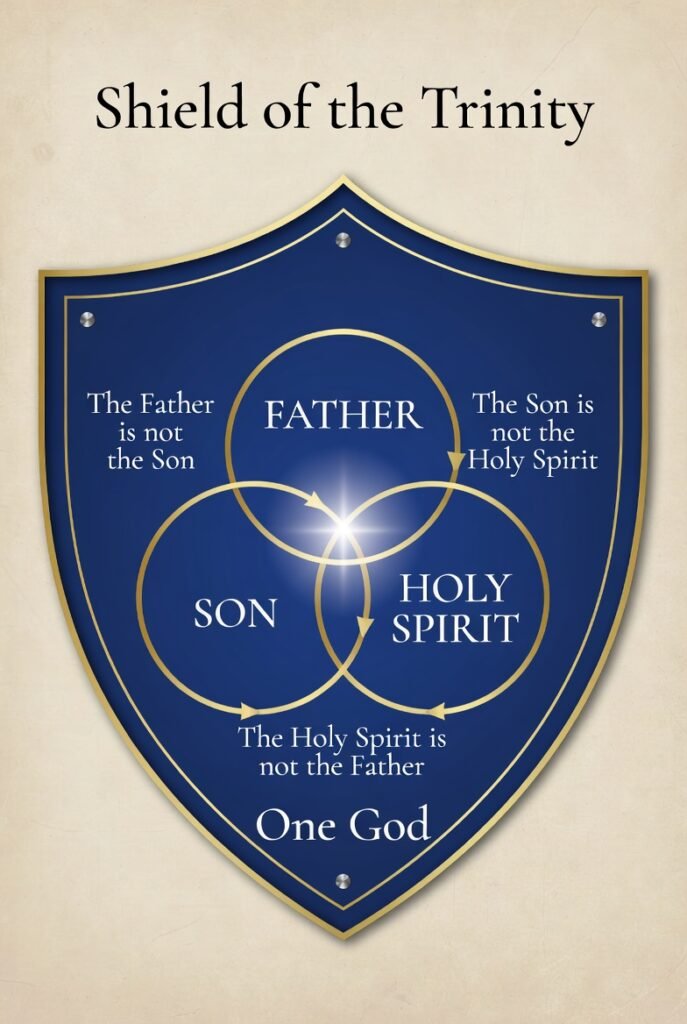
What Is the Trinity? A Practical Definition
The Trinity is the Christian doctrine that there is only one true God who exists forever as three distinct persons. Each person is fully God, yet there are not three Gods – only one. Each person is distinct from the other two, yet they are inseparably united in essence, power, glory, and purpose.
This is not:
- Three separate Gods (tritheism)
- One God wearing three different masks (modalism)
- A created being plus two others (Arianism)
Instead, Scripture presents a God whose very being is relational. Before creation, before time, the Father loved the Son (John 17:20-25), the Son obeyed the Father, and the Holy Spirit was present. Love, fellowship, and communication have always existed within God Himself. That eternal relationship is why “God is love” (1 John 4:8) is not just a slogan – it is the DNA of His nature.
For those who feel unprepared when skeptics challenge them, this definition gives a solid starting point: “We do not believe in three Gods. We believe in one God who has eternally existed as three persons.”
The Biblical Foundation of the Trinity
The word “Trinity” never appears in the Bible, yet the reality is everywhere once you know where to look. We begin with the Old Testament hints and move to the New Testament revelation.
Old Testament Hints of Plurality Within Unity
The Old Testament relentlessly declares God’s oneness:
“Hear, O Israel: The Lord our God, the Lord is one!” (Deuteronomy 6:4).
Yet the same Scriptures drop unmistakable clues of plurality:
- Genesis 1:26 – “Then God said, ‘Let Us make man in Our image, according to Our likeness…’” God speaks in the plural while creating in the singular.
- Genesis 3:22 – “Then the Lord God said, ‘Behold, the man has become like one of Us…’”
- Isaiah 6:8 – “Also I heard the voice of the Lord, saying: ‘Whom shall I send, and who will go for Us?’”
The Hebrew name Elohim is plural in form but paired with singular verbs, pointing to unity in diversity. These passages do not “prove” the Trinity on their own, but they prepare the ground for the clearer light of the New Testament.
New Testament Revelation: All Three Persons Appear Together
The Trinity steps into full view in the New Testament, especially around the ministry of Jesus.
The clearest single picture is the baptism of Jesus:
“When He had been baptized, Jesus came up immediately from the water; and behold, the heavens were opened to Him, and He saw the Spirit of God descending like a dove and alighting upon Him. And suddenly a voice came from heaven, saying, ‘This is My beloved Son, in whom I am well pleased.’” (Matthew 3:16-17)
- The Son stands in the water.
- The Spirit descends as a dove.
- The Father speaks from heaven.
All three are present, distinct, and divine at the same moment.
The Great Commission seals the pattern:
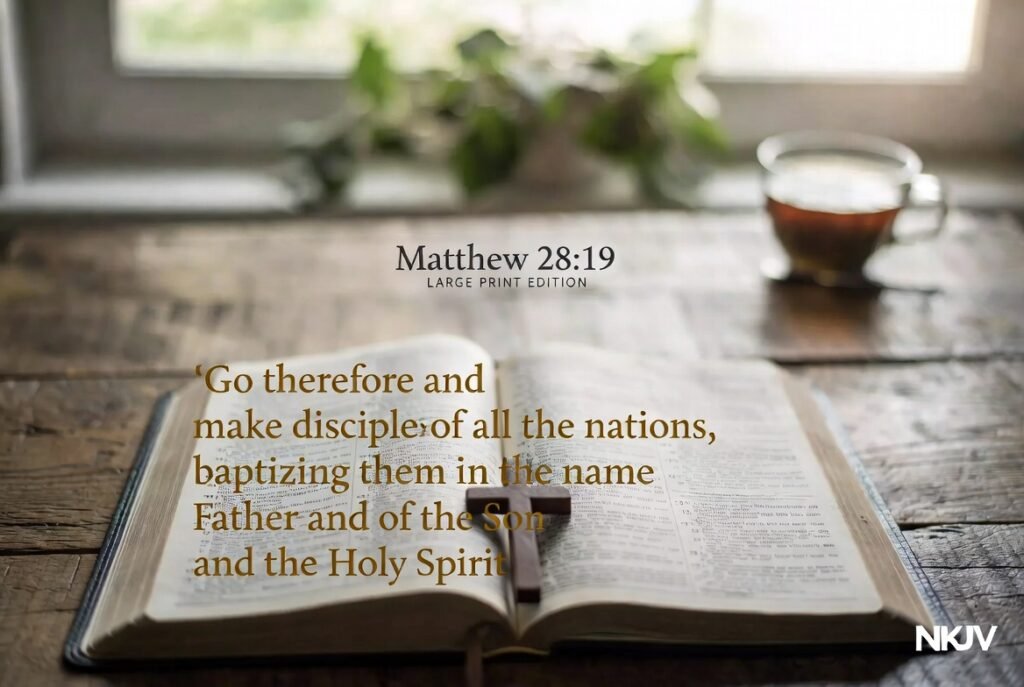
“Go therefore and make disciples of all the nations, baptizing them in the name of the Father and of the Son and of the Holy Spirit.” (Matthew 28:19)
Notice the singular “name” followed by three persons—unity and distinction in one breath.
Paul’s benediction is equally Trinitarian:
“The grace of the Lord Jesus Christ, and the love of God, and the communion of the Holy Spirit be with you all. Amen.” (2 Corinthians 13:14 NKJV)
John’s Gospel adds layer after layer. Jesus declares, “I and My Father are one” (John 10:30) and promises “another Helper” (John 14:16)—the Holy Spirit—who is clearly a person, not a force.
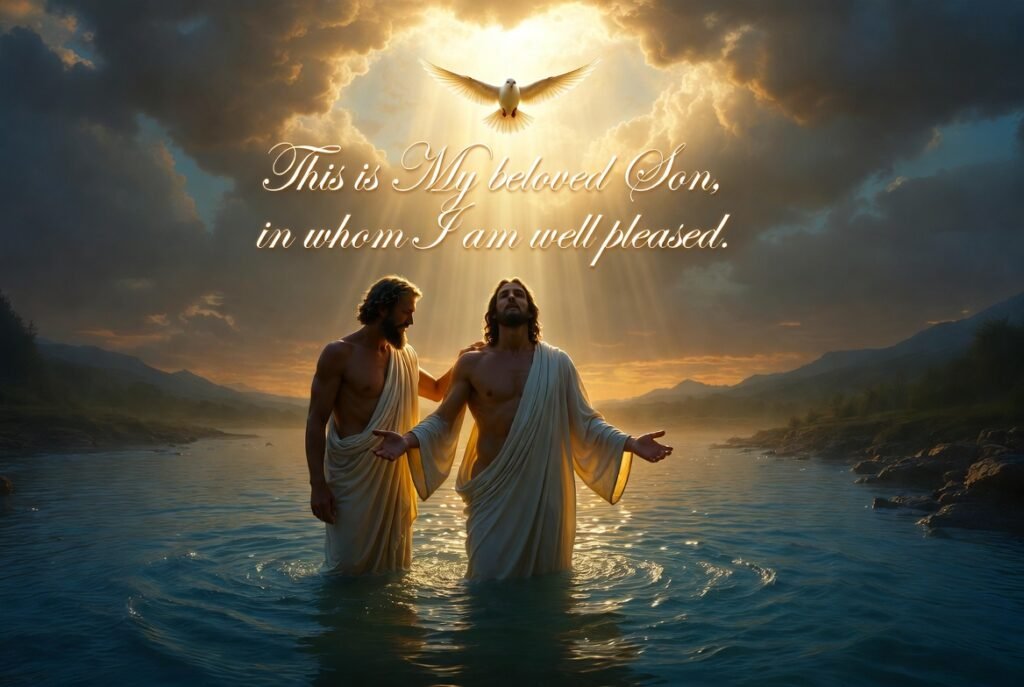
Artistic depiction of Jesus’ baptism in the Jordan
Understanding the Three Persons of the Trinity
God the Father – The Source and Sender
The Father is the eternal planner and initiator. He is the One Jesus addressed in prayer (Matthew 6:9) and the One who “so loved the world that He gave His only begotten Son” (John 3:16).
He is fully God—omnipotent, omniscient, and holy.
God the Son – Jesus Christ, Fully Divine and Fully Human
Jesus is not a junior god or a created being.
“In the beginning was the Word, and the Word was with God, and the Word was God… And the Word became flesh and dwelt among us.” (John 1:1, 14)
He openly claimed the divine name: “Before Abraham was, I AM” (John 8:58). Colossians 2:9 states, “For in Him dwells all the fullness of the Godhead bodily.” Jesus is 100 % God and 100 % man—the only bridge that can reconcile us to the Father.
God the Holy Spirit – The Indwelling Helper
The Holy Spirit is a person, not an “it.” He speaks (Acts 13:2), teaches (John 14:26), grieves (Ephesians 4:30), and can be lied to—with the consequence of lying to God Himself (Acts 5:3-4).
The Holy Spirit regenerates, indwells, and empowers every believer.
Each person (Father, Son, Holy Spirit) is fully God. None is subordinate in essence—only in role within the divine plan.
One Essence, Three Persons: Holding the Mystery
The three persons share the identical divine essence. They are co-eternal (no one came first) and co-equal (no one is lesser). Their roles differ beautifully: the Father sends, the Son obeys and redeems, the Spirit applies and empowers. Yet they never act independently; what one does, the others delight in.
Jesus captured this oneness in His high-priestly prayer: “that they all may be one, as You, Father, are in Me, and I in You” (John 17:21). The church is called to reflect the same unity that has always existed inside God.
For the mind trained in science or history, this is no more contradictory than quantum entanglement or the dual nature of light. God’s being is simply richer than our categories.
Common Analogies and Why They Fall Short
Many well-meaning teachers use illustrations: water in three forms, an egg with three parts, or a three-leaf clover. Each eventually breaks down. Water forms are modalistic (one substance changing modes). An egg’s parts are not each fully an egg. The clover’s leaves are not each fully the clover.
The wisest approach is humility: “No created analogy is perfect because nothing in creation is exactly like God. Let’s stay with what the Bible actually shows us.”
Answering Skeptical Questions and Overcoming Doubt
When a coworker says, “That’s three gods,” reply with Matthew 28:19—“one name, three persons.”
When a student asks, “How can 1+1+1 = 1?” answer, “It’s not addition; it’s one divine essence expressed in three persons.”
For those reeling from Old Testament violence or apparent contradictions, the Trinity offers comfort: God’s eternal love within the Godhead means judgment is never arbitrary; it flows from holy relational perfection.
The doctrine does not contradict reason—it transcends it, just as the incarnation does (God became human in Jesus Christ).
The Trinity in Daily Christian Life and Family Discipleship
- Prayer: We pray to the Father, through the Son, in the power of the Holy Spirit.
- Salvation: The Father planned it, the Son purchased it, the Spirit applies it.
- Worship: We glorify all three whenever we sing “Holy, Holy, Holy.”
- Parenting and Teaching: Read Matthew 3:16-17 with your children. Ask, “Who do you see here?” Then let the text speak. Role-play answering friends’ questions. Use the baptism story as your anchor illustration.
Conclusion: Living in the Reality of the Trinity
The Trinity is not an abstract doctrine reserved for theologians. It is the heartbeat of the Christian life. It explains why God is love, why salvation is Trinitarian, and why the church is called to unity.
With the Trinity explained through the clear witness of Scripture (Bible), you now have the tools to quiet your own doubts, answer your children’s questions, equip your students, and stand confidently before skeptics. Open your Bible, meditate on the verses we have studied, and ask the Holy Spirit to make this truth alive in your heart.
One God. Three persons. Infinite love. Eternal relationship. That is the God who invites you—right now—to know Him more deeply than ever before.
May the grace of the Lord Jesus Christ, the love of God the Father, and the fellowship of the Holy Spirit be with you today and always.
Leave a Reply