
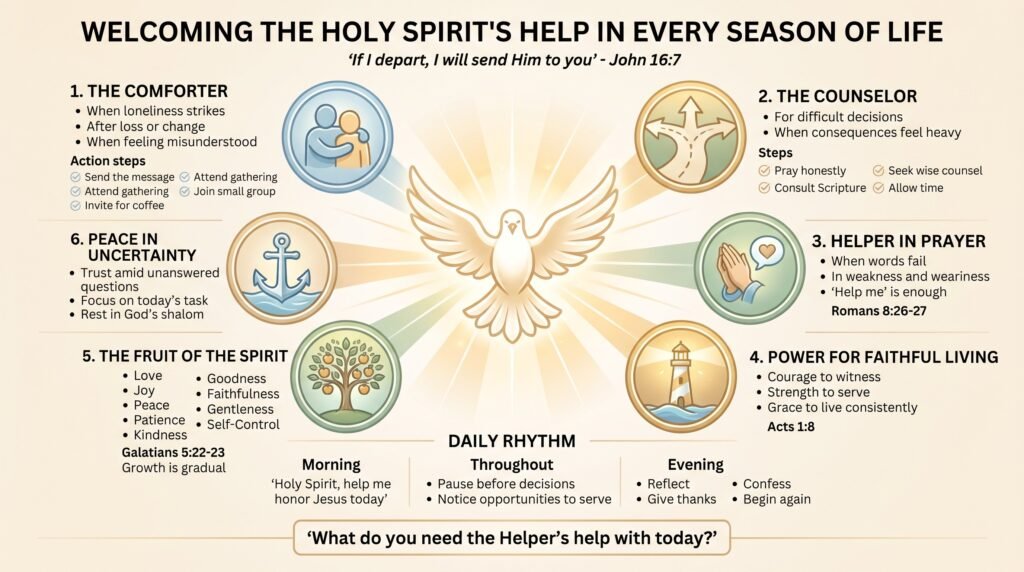
Welcoming the Holy Spirit’s Help in Every Season of Life
“if I depart, I will send Him to you.”
— John 16:7, NKJV, excerpt
Have you ever wished someone could sit beside you, understand everything you are carrying, and help you decide what to do next?
Perhaps the house has become quieter. The children have families of their own, your working life is changing, or someone you love is no longer there to share the ordinary moments. You may have people around you and still feel that nobody quite understands.
Or perhaps loneliness is not your greatest concern. You are facing a decision. Should you pursue that opportunity? How do you begin repairing a strained relationship? Is this a time to speak, to wait, or to change direction?
You have experience, but experience does not answer every question. You have faith, but some mornings your strength feels very small.
My dear friend, Jesus knew His followers would need help. He did not ask them to manage everything through determination and good intentions. He promised the Holy Spirit.
That promise still gives us reason for hope. We can bring our questions, weaknesses, disappointments, and responsibilities to God. We can learn to depend on the Helper Jesus promised.
Why Jesus Said His Departure Was to Our Advantage
Imagine hearing Jesus say that His going away would be for your benefit. For the disciples, who had walked with Him, listened to Him, and depended on His presence, those words must have been difficult to understand.
Yet in John 16:7, Jesus explained that His departure would be followed by the Helper’s coming. His leaving would not mean His followers were abandoned. God was providing for their continuing life and mission.
We often wish Jesus were physically beside us when life becomes confusing. We imagine asking Him a question across the kitchen table or hearing Him tell us what to do. His promise invites us to recognize the help God has already given through the Holy Spirit.
The Holy Spirit is a divine Person, not simply an uplifting feeling or a burst of spiritual energy. Christians confess one God: Father, Son, and Holy Spirit. When we speak of depending on the Spirit, we are speaking of a relationship with God.
We do not have to create His power or persuade Him to care. We begin by responding to His presence with trust and a willingness to follow.
A Comforter When Life Feels Lonely
Loneliness is not always obvious. Sometimes it appears in a busy home where the conversations have become practical and brief. Sometimes it arrives after retirement, when the daily contact of work disappears. Sometimes it comes after a funeral, when everyone else returns to normal, and your world remains painfully changed.
Faith does not require us to pretend those experiences do not hurt.
In John 14:16–18, Jesus promised an abiding Helper and reassured His disciples that they would not be left as orphans. That is a tender promise for anyone who feels forgotten. Your circumstances may have changed, but God has not lost sight of you.
You can speak honestly to Him: “Lord, I feel lonely today. I miss having someone to talk to. Please help me receive Your comfort and show me how to connect with others.”
There is no shame in that prayer. Admitting loneliness does not mean your faith has failed.
The Spirit’s comfort can accompany a quiet morning with Scripture, a memory that brings gratitude through tears, or the courage to answer a friend’s invitation. His care may reach you through another person’s kindness.
Make room for that possibility. Send the message. Attend the gathering. Invite someone for coffee. Ask your church about a small group or a place to serve.
God’s presence and human companionship belong together in a healthy Christian life. You can trust that God loves you while taking practical steps toward friendship.
A Counselor When You Do Not Know What to Do
Some decisions become harder with age because we understand their consequences more clearly. We know that a careless word can damage a relationship, an unwise commitment can consume savings, and a rushed choice can affect more people than ourselves.
So we ask our Counselor: “Lord, what should I do?”
The Holy Spirit helps us grow in discernment. Jesus described Him as the Spirit of truth, whose work points us towards Christ (John 16:13–14). His guidance belongs within a life shaped by Jesus and His teaching.
Begin with an honest account of the situation. Tell God what you want, what frightens you, and what you may be avoiding. It is difficult to listen openly when we are only looking for permission to do what we have already decided.
Then consider what Scripture makes clear. A hope for opportunity does not justify dishonesty. A strong attraction does not excuse unfaithfulness. A desire for peace does not make it wise to ignore harm.
Seek counsel from people who are both mature and willing to disagree with you. Depending on the decision, that may include a pastor, a trusted friend, or someone with relevant professional experience. Prayer and careful investigation can work together.
Finally, allow time when you can. Some answers emerge through patient consideration, conversations, and small steps. You may receive enough clarity for the next faithful action before you understand the whole journey.
You do not need to force certainty. You can ask for wisdom and remain teachable as you proceed.
Learning to Distinguish Guidance from Impulse
A thought can feel urgent without being wise. An opportunity can be attractive without being suitable. Even a sense of relief may mean that we have found a way to avoid something uncomfortable.
That is why humility matters when we say, “I believe God is leading me.”
We can take an impression seriously while still examining it. Does it agree with Scripture? Does it encourage honesty, love, and responsibility? Have we considered the people affected? Are we willing to receive correction?
Suppose you are considering a business venture. Pray about it, then examine the costs, commitments, and information available. Ask difficult questions. Do not treat enthusiasm as a guarantee of success or dismiss every concern as a lack of faith.
Or suppose you feel prompted to repair a relationship. A wise first step may be a humble message acknowledging your part. It may take time and appropriate boundaries for trust to grow again. You cannot control the other person’s response.
The Counselor does not make us incapable of mistakes. We remain capable of misunderstanding, impatience, and poor judgment. But we can become more willing to pause, listen, correct our course, and learn.
It’s comforting to know that God’s faithfulness does not depend on our ability to get everything right the first time.
Help When You Cannot Find the Words to Pray.
Some days prayer comes easily. Gratitude rises naturally, and you know exactly what to bring before God.
Other days you sit in silence. A loved one is suffering. A problem has continued for months. You are tired of explaining the same hurt, and you do not know what an answer would even look like.
Romans 8:26–27 describes the Spirit helping believers in weakness and interceding when they do not know how to pray as they ought.
You can come to God without a carefully prepared speech. “Help me” is an honest beginning. So is, “I do not know what to ask for today.”
You might sit quietly with an open Bible. You might write one sentence in a notebook. You might ask a trusted believer to pray with you because you cannot carry the conversation yourself.
God is not measuring the elegance of your words. You can bring Him the tiredness, confusion, and tears you would rather hide.
When you have little strength, take encouragement from this passage: prayer does not rest entirely on your ability to express yourself. Your weakness is a place where God’s help matters deeply.
Power for a Faithful Life
When we speak about the power of the Holy Spirit, we may picture something dramatic. Scripture certainly includes remarkable demonstrations of God’s power. Yet we should also consider what His empowering presence means for the ordinary responsibilities of a Christian life.
In Acts 1:8, Jesus connected the coming of the Holy Spirit with power to be His witnesses. The purpose extended beyond a private experience. His followers were being equipped to make Him known.
We need that help too. We need courage to speak about Christ with sincerity and respect. We need strength to keep serving when recognition is absent. We need grace to live consistently with what we say we believe.
Christian traditions understand aspects of baptism in the Holy Spirit and spiritual gifts differently. Whatever our church background, we can earnestly seek the Spirit’s filling and empowering, remain grounded in Scripture, and use what God gives us to serve others.
Ask Him for help in the area where obedience feels difficult. Perhaps you need courage to apologize, patience with someone whose needs are increasing, or strength to turn away from a habit that harms you.
Do not overlook these places of dependence. A faithful conversation, a generous act, or a restrained response can matter greatly to the person receiving it.
Look for Fruit as You Grow
Galatians 5:22–23 describes the fruit of the Spirit in terms of love, joy, peace, patience, kindness, goodness, faithfulness, gentleness, and self-control.
Those qualities give us a practical way to reflect on our growth. Are we becoming more willing to listen? Do we treat people kindly when we are tired? Are we keeping our promises? Can we admit a fault without immediately defending ourselves?
Growth is often gradual. You may still become frustrated, yet notice that you apologize sooner. You may still feel afraid, yet choose to act faithfully. You may discover that a person you once avoided is someone you can now treat with compassion.
Thank God for those changes. Then keep asking for His help.
When you fail, bring the failure into the light. Confess it, make amends where possible, and receive forgiveness. One impatient afternoon does not have to become a week of shame or an excuse to stop trying.
Walking with the Spirit involves repeated dependence. We learn, respond, stumble, and return. Over time, the people closest to us should be able to experience the difference His work is making.
Peace While the Questions Remain
Many of us want peace to arrive with a complete explanation. We would feel calmer if we knew when the problem would end, how the finances would work out, or whether the person we love would be all right.
Often, however, we must live faithfully before those answers come.
The biblical idea of shalom carries a richness of peace and well-being that reaches beyond a quiet afternoon. In Christian life, we look to God for a peace that can sustain us amid unfinished circumstances.
That does not require a permanent feeling of calm. You can trust God and still need time to settle after upsetting news. You can pray sincerely and still benefit from a conversation, rest, or practical support.
Try bringing one concern before Him at a time. Name what you can do today and what lies outside your control. Ask for help with your responsibility, and entrust the uncertain outcome to Him.
Perhaps today’s task is making the appointment, checking the facts, or having a kind conversation. Once you have taken that step, permit yourself to rest. You do not have to solve tomorrow’s questions before going to bed tonight.
Welcoming His Help into Ordinary Routines
We can become accustomed to asking God for help only when a situation has become overwhelming. Yet a daily relationship gives us many smaller opportunities to listen and respond.
Begin your morning with a simple prayer: “Holy Spirit, help me honor Jesus in my thoughts, words, and choices today.” Read a short passage of Scripture slowly enough to consider its meaning. Ask what faithful action it invites from you.
Before a difficult conversation, pause. Ask for patience and understanding. You may still need to say something firm, but you can seek help to say it without cruelty.
When resentment returns, acknowledge it. Ask God to work in your heart rather than rehearsing the offense all afternoon. Where a problem needs addressing, consider a constructive next step.
When you notice someone struggling, be willing to act. A message, a meal, a lift, or an attentive conversation may be within your reach. You don’t need an impressive role to be useful.
At the end of the day, reflect briefly. Where did you receive help? Where did you resist doing what you knew was right? Give thanks, confess honestly, and begin again tomorrow.
These ordinary habits make room for a life of attentive dependence on God.
There Is Still Purpose in This Season
After fifty, we may find ourselves measuring life against what has ended. A career slows down. Children need us differently. Physical energy changes. Plans we expected to fulfill remain unfinished.
It is natural to grieve a change. But an ending does not tell the whole story of your usefulness.
You can still encourage someone who feels discouraged. You can pray faithfully for your family. You can share a skill, welcome a neighbor, mentor someone younger, or become a dependable friend.
Ask the Holy Spirit to help you notice the opportunities within your actual life. Someone nearby may value your experience or appreciate your company.
Choose something sustainable. One regular commitment may bear more fruit than several ambitious promises you cannot keep. Leave room to receive as well as give; other people also need the opportunity to care for you.
Your worth has never depended entirely on your productivity. God loves you in seasons of activity and in seasons when you need considerable help yourself.
Let that security free you to serve with gratitude, according to the strength and opportunities you have today.
Let the Helper Help You
Perhaps you have believed in the Holy Spirit for years without often acknowledging your dependence on Him. Perhaps you have tried to manage every concern alone, then wondered why you feel so weary.
You can turn towards God today with a willing heart. Bring Him the decision you keep postponing, the relationship that troubles you, or the loneliness you have struggled to admit.
Ask for comfort. Ask for wisdom. Ask for the strength to do what is right. Then remain open to the ways His help may come: through Scripture, prayer, sound counsel, practical support, and opportunities to obey.
You do not have to manufacture a spiritual experience. You can begin with honest dependence and the next faithful step.
Jesus promised His followers help. Let us receive that promise with gratitude and keep learning to walk with the Holy Spirit throughout the years ahead.
A Prayer of Welcome and Dependence
Dear Holy Spirit, thank You for Your presence in my life. Forgive me for the times I have overlooked Your help and relied only on my own understanding.
Please comfort me where I am lonely and strengthen me where I am weary. Help me understand Scripture, recognize truth, and follow Jesus faithfully. Give me wisdom for the decisions before me and humility to receive correction.
Grow Your fruit in my life. Teach me to love patiently, speak kindly, forgive sincerely, and serve willingly. Help me recognize the people You have placed near me and the good I can do today.
When I do not know how to pray, help me in my weakness. When the way ahead is uncertain, give me courage for the next faithful step.
I welcome Your work in my life and place my trust in God afresh. May my life bring honor to Jesus. Amen.
What is one part of your life where you need the Helper’s help today? Take a quiet moment to bring it before God.
Scripture for Further Reading
- John 16:7: Jesus promises the Helper.
- John 14:16–18, 26: the abiding Helper and His teaching.
- John 16:13–14: the Spirit of truth glorifies Christ.
- Romans 8:26–27: help in weakness and prayer.
- Acts 1:8: power to witness.
- Galatians 5:22–25: the fruit of the Spirit and walking in the Spirit.
Scripture excerpt from the New King James Version®. Copyright © 1982 by Thomas Nelson. Used by permission. All rights reserved. Other biblical passages are referenced or paraphrased, not quoted.
Leave a Reply