
Speaking in Tongues: A Biblical Examination – What Scripture Really Teaches
In many Christian circles today, the topic of speaking in tongues generates strong emotions, division, and sometimes confusion. Some believers treat it as the primary evidence of being filled with the Holy Spirit. Others avoid it entirely or view it with suspicion. On sites like fruitfulafter50.com, where we seek mature, faith-based wisdom, it’s important to approach this subject with humility, love, and a commitment to what the Bible actually says – not traditions, personal experiences, or extremes on either side.
The Apostle Paul addressed this directly in 1 Corinthians 12–14 because the church in Corinth was misusing spiritual gifts, including tongues. The core problem then (and now) is often the same: pursuing spectacular gifts while neglecting the fruit of the Spirit and a genuine personal relationship with Jesus Christ.
The Warning from Jesus Himself
Jesus gave one of the most sobering warnings in Scripture:
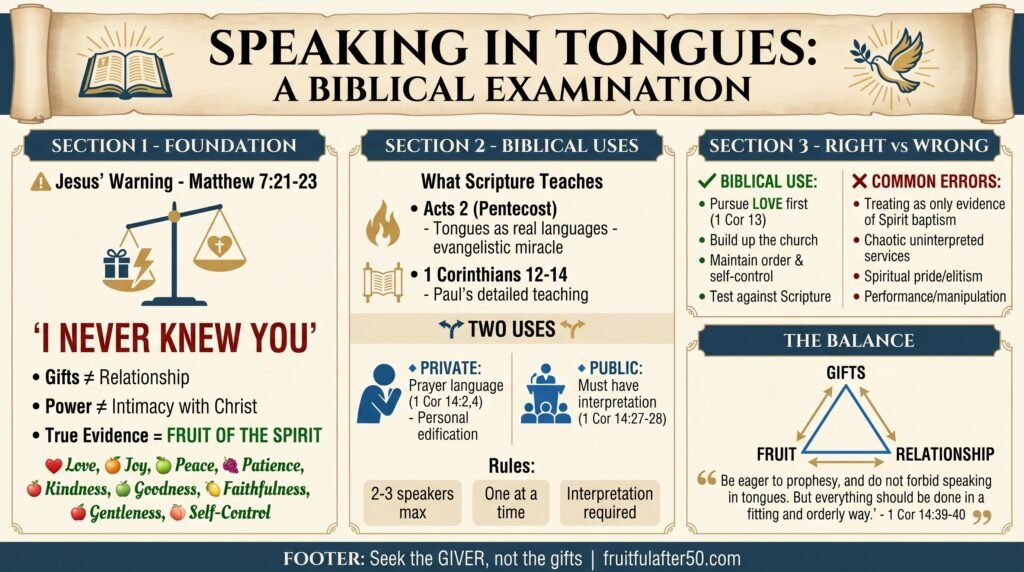
“Not everyone who says to me, ‘Lord, Lord,’ will enter the kingdom of heaven, but only the one who does the will of my Father who is in heaven. Many will say to me on that day, ‘Lord, Lord, did we not prophesy in your name and in your name drive out demons and in your name perform many miracles?’ Then I will tell them plainly, ‘I never knew you. Away from me, you evildoers!’” (Matthew 7:21-23, NIV)
This passage should shake every believer who operates in spiritual gifts. These people were exercising dramatic gifts – prophesying, casting out demons, performing miracles – yet Jesus declares, “I never knew you.” The issue wasn’t the absence of power or gifts. The issue was the absence of a real, intimate relationship with Him and the resulting fruit in their character.
The fruit of the Spirit – love, joy, peace, patience, kindness, goodness, faithfulness, gentleness, and self-control (Galatians 5:22-23) – is the true evidence of the Holy Spirit’s work in a person’s life. Gifts can operate temporarily or even through people whose hearts are not fully surrendered. Fruit grows from abiding in Christ (John 15).
This is the foundation we must establish before discussing tongues.
What Does the Bible Say About Speaking in Tongues?
The gift of tongues (Greek: glōssa, meaning languages) appears in several key passages:
- Acts 2:1-11 (Pentecost)
- When the Holy Spirit was poured out, the disciples “began to speak in other tongues as the Spirit enabled them.” Devout Jews from many nations heard them declaring the wonders of God in their own native languages. This was a public, evangelistic miracle: real human languages the speakers had not learned, enabling the Gospel to spread immediately.
- Other Instances in Acts
- Acts 10:44-46 (Cornelius’ household) – Tongues accompanied the Holy Spirit falling on Gentiles.
- Acts 19:1-6 – Disciples spoke in tongues and prophesied after Paul laid hands on them.
- These were often signs confirming the inclusion of new groups into the Church.
- 1 Corinthians 12–14 – Paul’s detailed teaching
- Paul lists “different kinds of tongues” among the gifts distributed by the Holy Spirit as He wills (1 Corinthians 12:4-11, 28-30). Not every believer has this gift.
Two Main Uses of Tongues in Scripture
A. Private / Personal Prayer Language
“For anyone who speaks in a tongue does not speak to people but to God. Indeed, no one understands them; they utter mysteries by the Spirit.” (1 Corinthians 14:2)
“Anyone who speaks in a tongue edifies themselves…” (1 Corinthians 14:4)
This appears to be a form of prayer or praise directed to God that bypasses the mind and engages the spirit. Paul himself said, “I thank God that I speak in tongues more than all of you” (1 Corinthians 14:18). Many mature believers find this helpful for personal devotion, intercession, and building up their inner man (Jude 1:20).
B. Public Message in Tongues (with Interpretation)
When used in the gathered church, tongues must be interpreted so the body can be edified. Without interpretation, it becomes unhelpful or even disruptive.
Paul’s clear instructions (1 Corinthians 14:27-28):
- Only two or at most three should speak in a tongue.
- They must speak one at a time.
- Someone must interpret.
- If no interpreter is present, the person should speak quietly to themselves and to God.
Paul emphasizes order: “God is not a God of disorder but of peace” (1 Corinthians 14:33). He also says he would rather speak five intelligible words to instruct others than ten thousand words in a tongue in public (1 Corinthians 14:19).
What Is Right: Biblical Use of Tongues
- Pursue love first – 1 Corinthians 13 (the love chapter) is placed deliberately between chapters 12 and 14. Without love, even the most impressive gifts are worthless.
- Desire gifts that build up the church – Prophecy (clear, understandable speaking forth of God’s truth) is generally preferred in public settings because it edifies everyone.
- Use tongues privately for personal edification and prayer.
- In public, ensure interpretation that strengthens the church.
- Maintain order and self-control – The Spirit does not override our self-control (one of the fruits of the Spirit).
- Test everything against Scripture and the character of Christ.
What Is Wrong: Common Misapplications Today
Many churches and believers fall into the very errors Paul corrected in Corinth:
- Treating tongues as the only or primary evidence of Spirit baptism.
- Chaotic services where many people speak in tongues simultaneously, with no interpretation -creating confusion rather than edification.
- Pride or spiritual elitism among those who speak in tongues versus those who do not.
- Using tongues as a performance or emotional manipulation instead of humble obedience.
- Claiming powerful gifts while living with unrepentant sin, bitterness, immorality, or lack of basic Christian character (the fruits of the Spirit).
Remember Matthew 7:21-23. Spectacular spiritual activity does not equal a genuine relationship with Jesus. Many will be surprised on judgment day.
The Balance: Gifts + Fruit + Relationship
The mature Christian life is not about chasing experiences or gifts. It is about:
- Knowing Jesus intimately (“I never knew you” is the ultimate tragedy).
- Walking in the fruit of the Spirit daily.
- Using any gifts God has given – including tongues – decently and in order for His glory and the building up of His people.
As Paul concludes in 1 Corinthians 14:39-40:
“Therefore, my brothers and sisters, be eager to prophesy, and do not forbid speaking in tongues. But everything should be done in a fitting and orderly way.”
Practical Guidance for Believers.
Wisdom and discernment matter more than ever. Here are some practical biblical applications:
- Seek the Giver, not the gifts. Pray for more of the Holy Spirit’s filling, which produces Christlike character.
- If you speak in tongues privately, use it to pray, worship, and intercede. It can be a wonderful blessing in your devotional life.
- In church, submit to pastoral leadership and the guidelines in 1 Corinthians 14.
- Test spirits and teachings (1 John 4:1). Any emphasis on tongues that neglects holiness, love, sound doctrine, or the clear preaching of Scripture should be examined carefully.
- Focus on legacy. As we age, what will matter most is not how dramatically the Spirit moved in a meeting, but whether our lives reflected the love, peace, patience, and faithfulness of Jesus to our families, churches, and communities.
The Holy Spirit is still active today. He distributes gifts as He wills for the common good. But the greatest evidence of His work is not tongues, prophecy, or miracles – it is transformed character that looks more and more like Jesus.
Let us pursue Him with all our hearts. Let us desire spiritual gifts, especially that we may prophesy truth clearly. And let everything be done for the glory of God and the building up of His Church – in love, order, and truth.
“Follow the way of love and eagerly desire gifts of the Spirit…” (1 Corinthians 14:1)
May we be found faithful, fruitful, and known by our Lord on that final day.
PS: Scripture quotations are from the NIV unless otherwise noted. Always study these passages in full context with prayer and the help of the Holy Spirit. Do a Biblical examination. Study topics like ‘Gifts of the Spirit’ vs ‘Fruit of the Spirit’. If this stirs questions in your heart, I encourage you to open 1 Corinthians 12–14 and Matthew 7 with a humble, teachable spirit. God honors those who seek Him in truth.
Leave a Reply