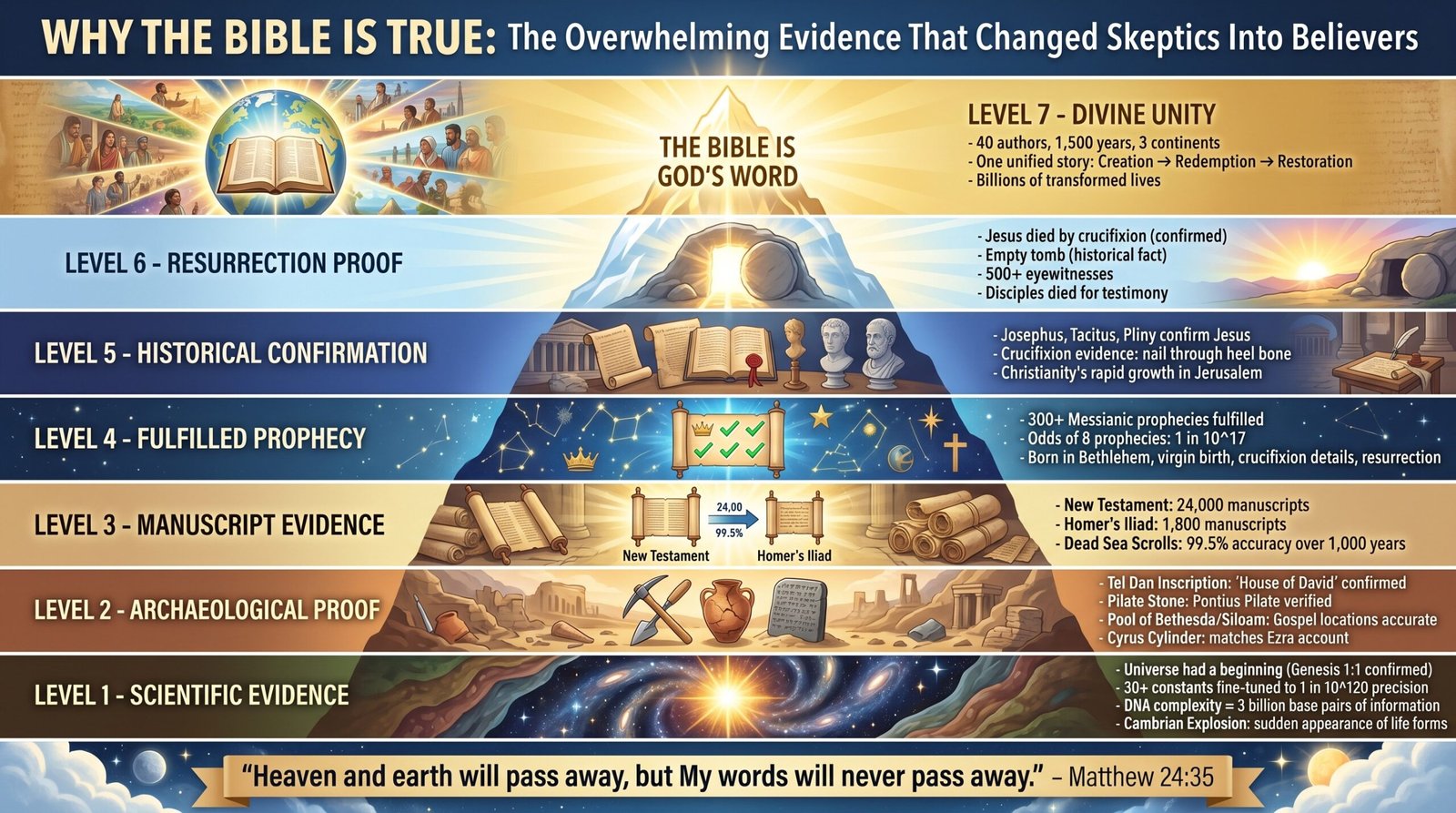
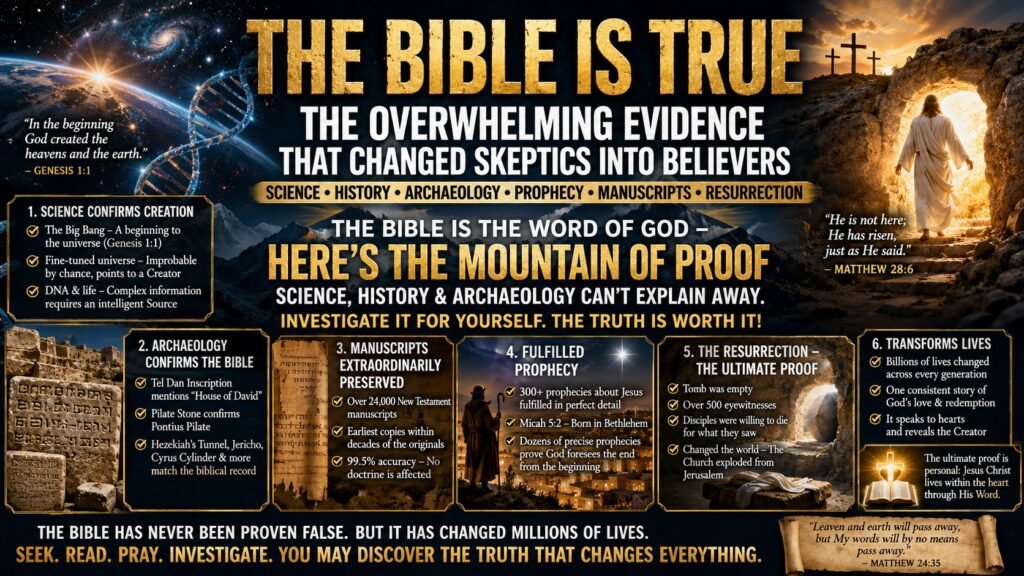
The Bible Is the Word of God – Here’s the Mountain of Proof Science, History & Archaeology Can’t Explain Away.
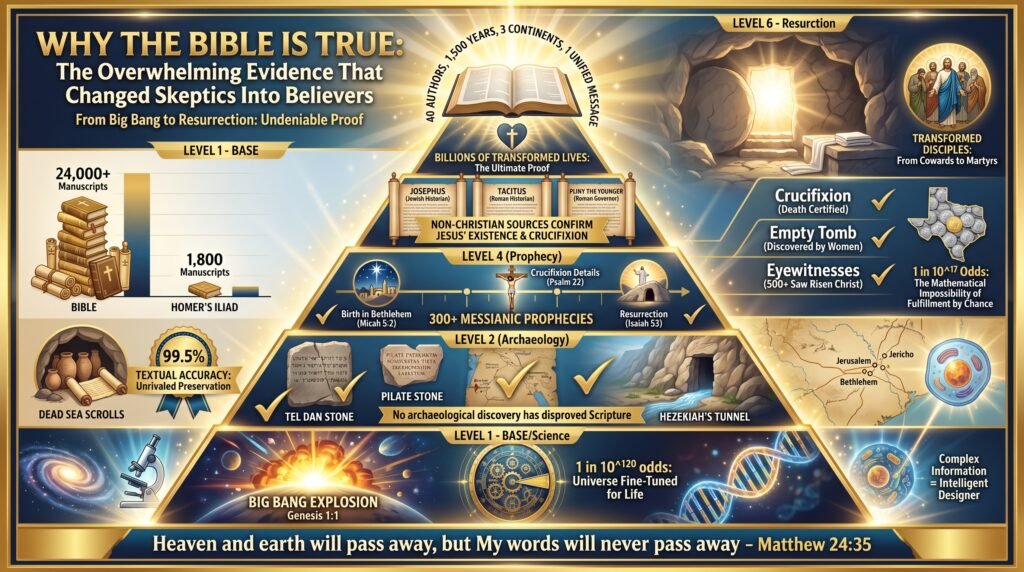
From Big Bang to Resurrection: Undeniable Evidence That the Bible Is True and God Is the Creator. This extensive report examines the evidence in chronological and logical order, beginning with Creation and culminating in the life, death, and resurrection of Jesus Christ. In response to the statement “Why the Bible is True: The Overwhelming Evidence that Changed Skeptics into Believers,” we encourage you to read through this complete report and then draw your own conclusion.
First up, some frequently asked questions:
Question 1: How do we know the Bible is reliable and not just made-up stories?
Answer: The Bible has far more ancient manuscripts than any other old book in history (over 24,000 for the New Testament alone). These copies are remarkably consistent, showing they have been carefully preserved for thousands of years.
Question 2: Does science contradict the Bible?
Answer: Actually, many scientific discoveries support the Bible. The universe had a beginning (the Big Bang), which agrees with Genesis 1:1 – “In the beginning God created…” The incredible fine-tuning of the universe and the complexity of DNA suggest an intelligent Creator, rather than random chance.
Question 3: Has archaeology proven the Bible wrong?
Answer: No. On the contrary, archaeology has repeatedly confirmed the Bible. Discoveries like the Tel Dan Inscription (mentioning King David), Pontius Pilate’s inscription stone, and Hezekiah’s Tunnel all match the biblical record exactly.
Question 4: How can we be sure the prophecies in the Bible are real?
Answer: The Bible contains hundreds of specific prophecies that came true. For example, the prophet Micah said the Messiah would be born in Bethlehem (Micah 5:2) — 700 years before Jesus was born there. Many other prophecies about Jesus were fulfilled in detail.
Question 5: What is the strongest proof that the Bible is true?
Answer: The resurrection of Jesus Christ. The early disciples were willing to die for their claim that they saw the risen Jesus. People don’t die for something they know is a lie. The rapid spread of Christianity in the city where Jesus was crucified is powerful evidence.
Question 6: Why should I trust the Bible over other religious books?
Answer: The Bible is unique because it was written by 40 different authors over 1,500 years, yet it tells one consistent story of God’s love and redemption. It has changed millions of lives and has never been proven false.
Question 7: How can someone know the Bible is God’s Word personally?
Answer: Millions of people have experienced Jesus speaking to their hearts through the Bible. As the Bible itself says: “The word of God is living and powerful…” (Hebrews 4:12). When you read it with an open heart, God often confirms its truth to you personally.
The Bible is the Word of God.
I know it is true because Jesus lives within my heart. I believe everything is created. I believe in the Creator.”
This sincere testimony reflects the personal experience of hundreds of millions of believers throughout history. While the deepest conviction comes from the indwelling presence of Christ through the Holy Spirit, the Bible also stands firmly under the scrutiny of history, science, archaeology, manuscript evidence, and prophecy. It is not a collection of myths or moral fables but God’s self-revelation in real time and space.
This extensive report examines the evidence in chronological and logical order, beginning with Creation and culminating in the life, death, and resurrection of Jesus Christ. The cumulative case strongly supports the conclusion that the Bible is the inspired Word of the Creator of the universe.
1. Scientific Evidence for Creation: Challenges to Purely Naturalistic Explanations
The Bible opens with a clear declaration: “In the beginning God created the heavens and the earth.” (Genesis 1:1, NKJV). This declaration is remarkably consistent with modern scientific discoveries.
While many accept this by faith, a growing body of scientific observations has led numerous scientists and philosophers to conclude that the universe and life show strong evidence of intelligent design rather than purely unguided natural processes.
The Big Bang and the Origin of the Universe
Modern cosmology confirms the universe had a definite beginning – an event now known as the Big Bang. Discovered through cosmic microwave background radiation and the observed expansion of space (Hubble’s Law), this singularity points to a point where space, time, matter, and energy came into existence from nothing.
Physicist Stephen Hawking acknowledged that the Big Bang raises the question of what (or Who) initiated it.
Even more compelling is the fine-tuning of the universe. Over 30 fundamental physical constants (the gravitational constant, the strong nuclear force, the electromagnetic force, the cosmological constant, the ratio of electron to proton mass, etc.) are tuned with mind-boggling precision. If any of these constants varied by even a tiny fraction, the universe would be incapable of supporting stars, planets, chemistry, or life.
Astrophysicist Fred Hoyle famously remarked that the universe looks like “a put-up job.” The odds of such fine-tuning occurring by chance are estimated by some physicists as 1 in 10^120 or greater – effectively impossible under naturalistic models. This “anthropic principle” leads many scientists to conclude that intentional design by an intelligent Mind is the most reasonable and logical explanation.
The Origin of Life (Abiogenesis)
Even if the universe began, the leap from non-living chemicals to living cells remains one of science’s greatest unsolved problems. The simplest living cell requires vast amounts of complex, specified information encoded in DNA, along with molecular machines (proteins, ribosomes, etc.) working in precise coordination.
No laboratory experiment has ever produced a living cell from non-living matter. Experiments like the Miller-Urey experiment produced only simple amino acids under highly artificial conditions – far short of the functional complexity needed for life. No plausible naturalistic pathway has been demonstrated for the spontaneous generation of the genetic code, cell membranes, or metabolic systems.
Decades of subsequent research have failed to bridge the enormous gap. The origin of biological information strongly implies an intelligent Source – consistent with the biblical Creator who spoke life into existence.
Biological Complexity and the Fossil Record
The theory of unguided evolution faces significant challenges. The Cambrian Explosion, around 530 million years ago, marked the sudden appearance of nearly all major animal body plans in the fossil record, with very few transitional forms beforehand. This “explosion” of complexity in a relatively short geological period is difficult to reconcile with slow, gradual Darwinian processes.
At the molecular level, systems such as the bacterial flagellum (a microscopic rotary motor) exhibit irreducible complexity – all parts must be present and functioning for the system to work. Biochemist Michael Behe and others have highlighted how such systems resist explanation by gradual mutation and natural selection.
The Testimony of Genetics
DNA functions as a digital information system far more sophisticated than any human-created code. The human genome contains approximately 3 billion base pairs with layers of regulatory information. As the Bible states in Psalm 139:14, we are “fearfully and wonderfully made.”
The sheer volume of specified complexity points strongly toward an intelligent source, consistent with the biblical view that God spoke creation into existence.
Many scientists in the Intelligent Design movement (including biochemist Michael Behe, mathematician William Dembski, and others) argue that the evidence best fits the hypothesis of a rational, orderly, and purposeful Creator.
Faith and Science in Harmony
Belief in the Creator does not require rejecting all science. Many discoveries (the universe had a beginning, the fine-tuning of physical laws, the information-rich nature of life) align remarkably well with the biblical worldview. As the Apostle Paul wrote, God’s “invisible attributes are clearly seen… by the things that are made” (Romans 1:20).
While mainstream science largely attributes these phenomena to natural processes and unguided evolution over billions of years, the philosophical assumptions of naturalism are not themselves scientific proofs. The Bible’s claim of a personal Creator who spoke the universe into being and formed life with purpose remains a powerful and coherent explanation of the evidence.
2. The Exodus and Archaeological Corroboration of Biblical History
The Bible records God’s dramatic intervention in human history through the people of Israel.
One of the most dramatic events in the Old Testament is the parting of the Red Sea and the destruction of Pharaoh’s pursuing army as described in Exodus 14. The Bible records that the waters returned and covered the chariots, horsemen, and all the host of Pharaoh (Exodus 14:28).
Popular claims have circulated for decades regarding physical evidence of this event. In the late 1970s and 1980s, explorer Ron Wyatt reported discovering coral-encrusted chariot wheels, axles, human and horse bones, and other artifacts on the seabed in the Gulf of Aqaba near Nuweiba Beach. Some of these objects were said to resemble 18th Dynasty Egyptian chariot wheels (with four, six, or eight spokes), consistent with the period many associate with the Exodus. Videos and photographs showing wheel-like formations and a gilded wheel have been widely circulated among believers.
Supporters argue these finds align with the biblical account of a large Egyptian force perishing in the waters. Some later divers and researchers have reported similar observations in the area.
Important Caution and Scholarly Consensus
While these claims are compelling to many and continue to inspire faith, they remain highly controversial and are not accepted as verified archaeological evidence by mainstream scholars and archaeologists. Ron Wyatt was not a trained archaeologist, and his discoveries have not undergone rigorous peer-reviewed scientific analysis or official excavation documentation.
Critics, including marine biologists and biblical archaeologists, point out that:
- Coral formations in the Red Sea can naturally form wheel- or axle-like shapes.
- Some photographed objects have been identified by experts as possibly modern marine equipment (such as ship pulleys) rather than ancient chariot parts.
- No artifacts from these claimed discoveries have been recovered, carbon-dated, or housed in reputable museums for independent verification.
- No official Egyptian or international archaeological project has confirmed the presence of a large Egyptian army on the seabed at the site.
Major Christian and creationist organizations, as well as academic outlets in biblical archaeology, generally classify these specific Red Sea chariot finds as unconfirmed or unreliable. While the lack of confirmed physical chariot wheels does not disprove the Exodus (as organic materials and metal objects from that era would degrade or become heavily encrusted over 3,400+ years), it means this particular evidence should be approached with discernment.
While popular claims of coral-encrusted Egyptian chariot wheels discovered in the Gulf of Aqaba remain unverified by mainstream archaeology and are considered controversial, broader archaeological and historical patterns lend significant support to the Exodus narrative. Evidence of Semitic slave populations in Egypt, sudden changes in settlement patterns in Canaan during the late Bronze Age, and the rapid emergence of ancient Israel as a distinct culture align with the biblical timeline.
Later Old Testament history is richly confirmed.
- The Tel Dan Inscription (9th century BC) mentions the “House of David,” confirming King David’s dynasty—the first extra-biblical reference.
- Hezekiah’s Tunnel in Jerusalem matches the account in 2 Kings 20:20.
- The Cyrus Cylinder confirms the Persian king Cyrus’s policy of allowing exiles to return, aligning with Ezra.
- Discoveries at Jericho, Hazor, and other sites support conquest narratives (with ongoing scholarly discussion on specifics and dating).
Ongoing discoveries continue to illuminate the world of the patriarchs, kings, and prophets.
New Testament examples:
- The Pilate Stone (1961) confirms Pontius Pilate as prefect of Judea.
- The Pool of Bethesda and the Pool of Siloam in Jerusalem match John’s Gospel descriptions.
- A crucified man’s heel bone with a nail (Yehohanan) confirms Roman crucifixion practices, including details in the Gospels.
No archaeological discovery has ever conclusively disproved a major historical claim of Scripture. On the contrary, the more we dig, the more the biblical record is vindicated as a reliable historical document.
3. Manuscript Evidence: The Bible’s Extraordinary Textual Preservation
One of the strongest pieces of evidence for the reliability of the Bible is the sheer volume and quality of its manuscript tradition.
Old Testament: Jewish scribes treated the text with reverential care. The discovery of the Dead Sea Scrolls (1947–1956) provided manuscripts dating from the 3rd century BC to the 1st century AD. The Great Isaiah Scroll is nearly identical to the medieval Masoretic Text used today — separated by more than 1,000 years. This demonstrates astonishing accuracy in transmission.
New Testament: We possess approximately 5,800–6,000 Greek manuscripts, plus more than 19,000 in Latin, Syriac, Coptic, and other languages – a total of around 24,000–25,000 copies. The earliest fragments (such as the John Rylands Papyrus, containing John 18) date to about AD 125, within decades of the original writings (AD 50–100).
By comparison, other ancient works fare much worse. Homer’s Iliad has roughly 1,800 manuscripts, with the oldest copy dating back 500 years. Most classical authors have far fewer copies with much larger time gaps.
Textual scholars estimate the New Testament is preserved at 99.5% accuracy or higher. The vast majority of variants are minor (spelling, word order, or style), and none affect any core Christian doctrine. Sir Frederic Kenyon, former director of the British Museum, concluded: “The interval between the dates of original composition and the earliest extant evidence becomes so small as to be negligible, and the last foundation for any doubt that the Scriptures have come down to us substantially as they were written has now been removed.”
We can have high confidence that today’s Bible accurately represents the original inspired writings.
4. Fulfilled Prophecy: Clear Evidence of Divine Foreknowledge
The Bible contains hundreds of specific prophecies, many of which were fulfilled in precise detail — something impossible without supernatural knowledge.
Messianic Prophecies (More than 300 prophecies point directly to Jesus Christ):
- Born in Bethlehem (Micah 5:2 → Matthew 2:1).
- Born of a virgin (Isaiah 7:14 → Matthew 1:18-25).
- Betrayed for 30 pieces of silver (Zechariah 11:12-13 → Matthew 26:15).
- Crucified with pierced hands and feet (Psalm 22:16 → John 20:25).
- Lots cast for His garments (Psalm 22:18 → John 19:23-24).
- No bones broken (Psalm 34:20 → John 19:33).
- Resurrection (Psalm 16:10 → Acts 2:31).
Mathematician Peter Stoner calculated the odds of one person fulfilling just eight major prophecies as 1 in 10^17- equivalent to covering Texas in silver dollars two feet deep and finding one marked coin on the first try. Jesus fulfilled dozens.
Other Remarkable Prophecies include Isaiah naming Cyrus as the conqueror of Babylon 150 years before he was born (Isaiah 45:1) and detailing judgments upon ancient cities such as Tyre, Nineveh, and Babylon that were fulfilled exactly as predicted.
This body of fulfilled prophecy provides powerful evidence that the Bible is the Word of the eternal God who declares “the end from the beginning” (Isaiah 46:10).
5. External Historical Corroboration
Non-Christian historians and archaeological finds independently confirm many biblical details:
- Flavius Josephus (Jewish historian, ~AD 93): Mentions Jesus, His brother James, John the Baptist, and crucifixion under Pilate.
- Tacitus (Roman historian, ~AD 116): Records Christus’s execution under Pontius Pilate during Tiberius’s reign and the spread of Christianity.
- Archaeological discoveries include the Pilate Stone, the Pool of Bethesda, the Pool of Siloam, and skeletal evidence of Roman crucifixion.
- Pliny the Younger, Suetonius, and the Babylonian Talmud provide additional references.
These hostile or neutral sources affirm Jesus’s existence, crucifixion, and the early Christian movement’s rapid growth despite persecution. These sources confirm the historical setting and key figures of the New Testament.
6. The Resurrection of Jesus Christ: The Ultimate Validation
The resurrection is the cornerstone of the Christian faith and the supreme validation of the Bible’s message. The earliest Christian creed in 1 Corinthians 15:3-8 dates to within 2–5 years of the events and lists named eyewitnesses, many of whom were martyred for their testimony.
Even many skeptical scholars accept three key facts:
- Jesus died by Roman crucifixion.
- The tomb was found empty.
- The disciples sincerely believed they encountered the risen Jesus.
No naturalistic explanation (body theft, hallucination, swoon theory, or wrong tomb) adequately accounts for the transformation of fearful disciples into bold witnesses who turned the world upside down, or the rapid growth of Christianity in the very city where Jesus was crucified.
The resurrection confirms Jesus’ divine claims and establishes the Bible as the trustworthy Word of God.
7. The Unity, Influence, and Transformative Power of Scripture
The Bible was written by approximately 40 authors over 1,500 years on three continents in three languages – yet it tells one unified, coherent story of Creation, the Fall, Redemption through Christ, and final Restoration.
Its moral and spiritual influence on Western civilization, human rights, law, education, science, and the arts is unmatched. More importantly, billions of people across centuries testify that the living God has transformed their lives through His pages.
The personal testimony at the beginning of this report is not unusual – it is the common experience of those who encounter the risen Christ in the pages of Scripture.
Conclusion: The Bible Is the Word of God
From the fine-tuned creation of the universe, through the historical record of Israel, the extraordinary preservation of its text, the fulfillment of hundreds of prophecies, external historical confirmation, and the resurrection of Jesus Christ, the evidence overwhelmingly supports the Bible as the inspired Word of the living Creator.
The same God who spoke the cosmos into existence stepped into history in the person of Jesus Christ to redeem fallen humanity. He offers forgiveness, new life, and an eternal relationship with Him.
“Heaven and earth will pass away, but My words will by no means pass away.” (Matthew 24:35, NKJV)
The Bible has withstood every challenge for thousands of years. It continues to invite honest seekers to examine its claims. For those who respond in faith, the ultimate proof is deeply personal: Jesus Christ lives within the heart, just as the opening testimony declares.
The Bible is true. It is the Word of God. It reveals the Creator of all things – and He is calling you to know Him.

Leave a Reply